I. Overview
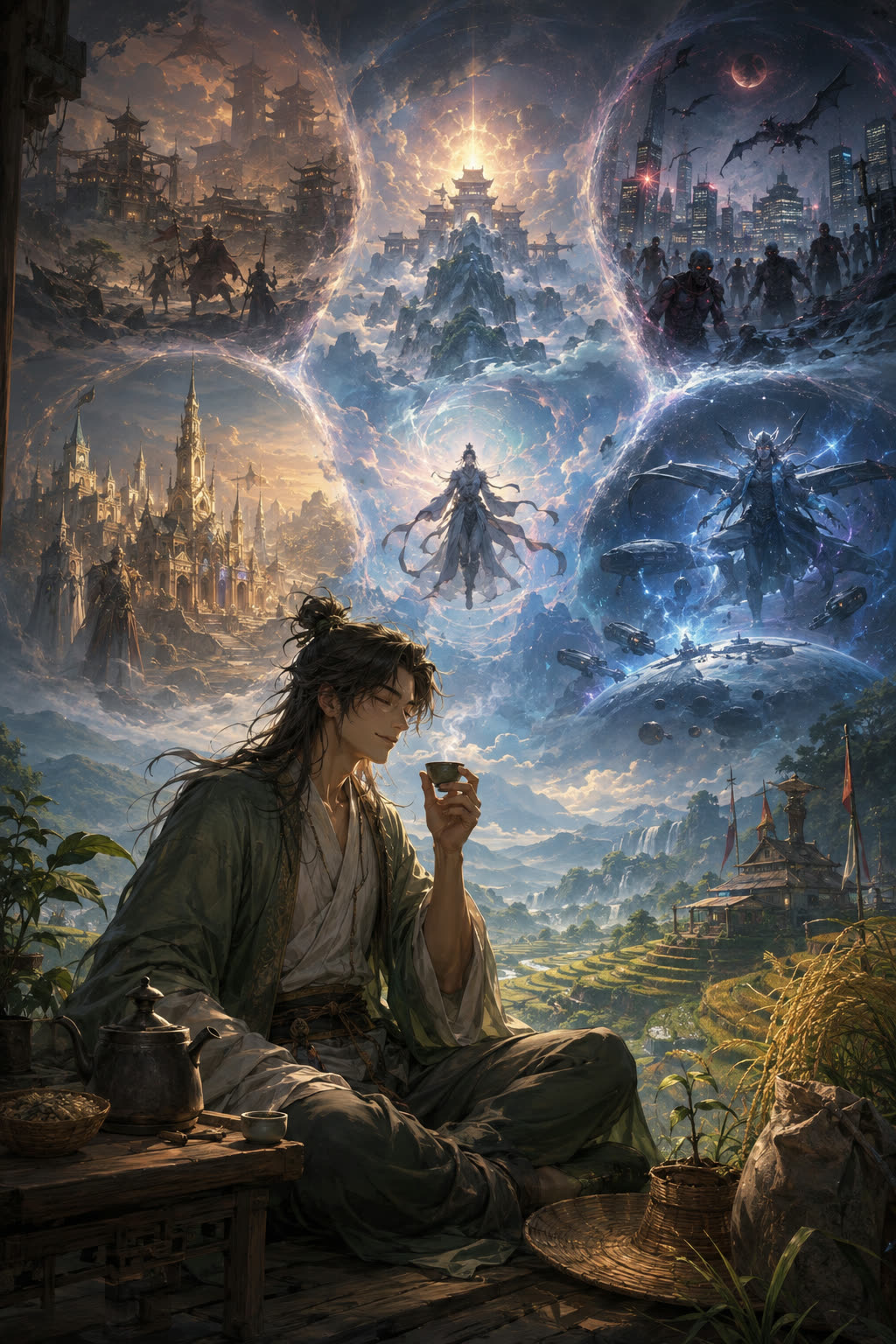
Carefree Path of Dreams follows a mountain hermit who farms, brews tea, and naps, then wakes up inside a game-like dream panel that turns his quiet hobbies into raw power, and ends by conquering the myriad worlds without ever meaning to. The Plagiarist writes cultivation as a cozy grind, and Fang Yuan is the genre’s most relaxed apex predator. The book’s own joke is that a man who just wanted to grow good rice somehow becomes the boss of every universe.
The book opens with Fang Yuan calmly handing a severed engagement contract back to the richer girl’s family and pocketing the compensation, then returns to his spirit fields and discovers his dream panel levels his farming into miracle crops. He brews a cup of his own spirit tea, watches his spirit stat tick upward, and decides the outside world might be worth a look. That unhurried curiosity drives the whole ascent.
The world widens by leaps, from a single misty valley and its petty martial sect, into a continent of warring kingdoms and dream masters, then across shattered realms of river gods and true sages, a modern city overrun by vampires and ghouls, a Western land of the Church and the Sun God, an immortal spirit dimension, a star-faring age of mechs and hive queens, and finally the seat of a Wanderer who bends the laws of every universe. Fang Yuan walks through each door himself, and the dream always travels with him.
The book’s charm is its contradiction: Fang Yuan schemes like a veteran and relaxes like a retiree, treating apocalypses as gardening weather. His tea ceremonies and quiet valleys keep a human warmth under the godhood. The novel runs long and stuffs itself with systems and worlds, but the calm center never breaks, and that unhurried voice is the whole appeal.
II. Highlights
The engagement he returned without blinking
Two visitors arrive to cancel Fang Yuan’s childhood betrothal now that the girl has joined a powerful sect. He listens, fetches the contract, and signs it over with a smile, then accepts the apology gift of a land deed, silver, and a pouch of spirit-rice seed. The men leave embarrassed; Fang Yuan goes back to planting. The scene sets his whole character in one page: unbothered, practical, and already playing a longer game than anyone suspects.
The tea that made a man weep
Fang Yuan serves his self-brewed spirit tea to a visiting herb trader and watches the man burst into tears, confessing through sobs that a sect paid him to cut off the hermit’s supply. The tea only scrubs the mind clean, but the trader’s own guilt does the rest. Seeing a grizzled old man crumble over a cup of leaves is the book’s signature blend of the mundane and the uncanny.
The dream master who steps out of the trap
Centuries later, Fang Yuan comprehends the law of the illusion world and gains the power to teleport. An immortal seals the region with a killing array, certain the catch is sealed, and Fang Yuan simply vanishes between heartbeats, reappearing miles away with a grin. From that moment no barrier or enemy lock can hold him, and the multiverse opens like a unlocked door.
Conquering the myriad worlds by accident
The finale finds Fang Yuan enthroned as a Wanderer above the universes, the quiet farmer now the law that other gods answer to. The book closes on the same joke it opened with: he never set out to rule anything, he just kept tending his garden until the garden became everything. Few power fantasies earn that shrug as well as this one does.
IV
Should you read it?
Reasons to read
- The cozy-cultivator voice is rare and addictive: a protagonist who would rather farm than fight, yet out-plans everyone anyway.
- The world-hopping delivers constant novelty, with a fresh setting and rule set every few hundred chapters.
- The dream-panel system makes the power growth legible and satisfying for progression fans.
- Carefree Path of Dreams follows a mountain hermit who farms, brews tea, and naps, then wakes up inside a game-like dream panel that turns his quiet hobbies into raw power, and ends by conquering the myriad worlds without ever meaning to. The Plagiarist writes cultivation as a cozy grind, and Fang Yuan is the genre's most relaxed apex predator. The…
Reasons not to read
- Romance is basically absent, so readers hunting a love story will leave empty-handed.
- The length is real, and the middle can drag through repeated grind-and-tournament cycles.
- The tone stays emotionally flat by design, which some readers find cold.
- The imported guide still needs a final editorial pass.
Who it fits
- Readers who like system novels, progression fantasy, and a calm anti-hero who wins without raising his voice.
- Anyone tired of angsty cultivation leads and looking for a lighter, wittier climb.
- Conversely, if you want romance, emotional drama, or literary depth, this quiet grind will not scratch that itch.
- Readers exploring Chinese web fiction.
- Anyone tired of angsty cultivation leads and looking for a lighter, wittier climb.
- Conversely, if you want romance, emotional drama, or literary depth, this quiet grind will not scratch that itch.
- Readers looking for a different reading experience.
Reader community
Would you recommend it?
Register or sign in to recommend this novel and comment.
Reader comments
0 comments