I. Overview
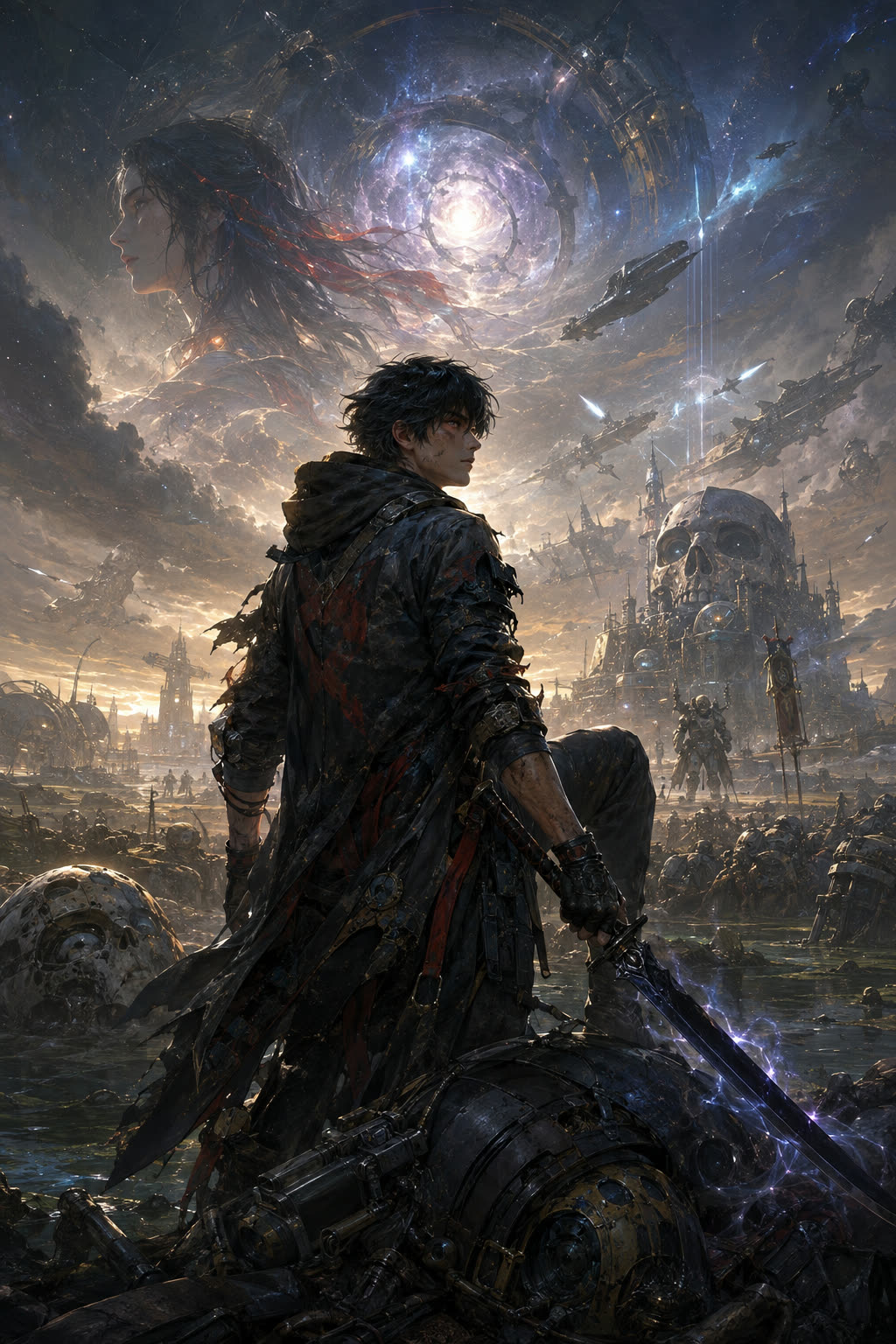
Forty Millenniums of Cultivation bolts xianxia onto a star-faring industrial society, the Chinese answer to a mecha space opera wired to a cultivation manual. Li Yao opens the book as a scavenger kid in the Artifact Graveyard, a federal dump where broken flying swords and dead battle suits rot in toxic swamps. He strips wrecks for parts and sells them to eat. A battered black sword and the ghost of a long-dead refining master pull him toward the craft, and his edge stays plain: he thinks like an engineer, not a mystic. He tears every relic down to its circuits and rebuilds it better.
The early books run on grime and nerve. Li Yao claws out of the slums, fixes a holographic projector, talks his way past bullies, aces a brutal entrance exam, and joins the Grand Desolate War Institute. The turn lands when he hears that cultivators are the battle blade of human civilization and his sleeping talent ignites. From there he refines suits, fights demon beasts, and earns the nickname Vulture by surviving where elites die.
Li Yao’s battlefield grows in rings. It starts in the garbage town of Floating Spear City, spreads to the star-faring Tianyuan Sector and its federation, reaches the Flying Star belt and the isolated Iron Wall tribes, then the Blood Demon frontier where humankind meets the demon races. The Ancient Saint ruins hide a fake immortal, the True Human Empire at the galaxy’s core breeds the cruel Black Star Emperor, the Holy Alliance guards elder civilizations, the Pangu genesis vaults wait underneath, and Earth itself closes the saga by revealing the whole story as something someone is writing.
Momentum and stubborn hope drive the book. Li Yao never becomes a sage. He stays a foul-mouthed tinkerer who builds bombs and colossal war machines and shields the weak because someone once shielded him. His bond with Ding Lingdang, the fiery girl who dragged him into the institute and later became his wife, keeps the cold void human. The book claims a cultivator serves the strong so the strong serve everyone else, and it pays that claim across ten million characters.
II. Highlights
The Vulture claims the dump
In the opening, Li Yao crouches behind a trash mountain as a federal garbage ship dumps its load. He launches off the exploding wreck on his black sword, threads the spiritual shockwave, and snatches the richest payload while taunting a fat rival who slipped in the mud. The scene sets the whole book in one breath: a poor kid who treats a toxic wasteland like a treasure vault and a fight like a business deal.
A fake immortal meets a hardheaded warlord
In the Ancient Saint arc, a voice from inside a skull-shaped war machine calls itself the Thundercloud Immortal and offers the young emperor godhood for loyalty. Han Baling, a steppe warlord with nothing to lose, shreds the act in front of the whole assembly. He asks why a real god would hide, why he covets mortal relics, and why he backed the weakest claimant. The fraud goes silent, and the reader watches reason disarm a god.
A planet run as a live-weapon range
The True Human Empire’s homeworld, renamed Sinful Soil, drops amnesiac “grandfathers” from orbit into a starving wasteland. Li Yao realizes the grisly truth: the empire seeds unstable new techniques into slaves and watches them kill each other testing the weapons. An entire world serves as a firing range for the strong. The twist turns a familiar power climb into a horror story about who pays for progress.
The reader picks up the phone
The finale jumps to a modern dorm, where a college student named Li Yao screams “Cultivator, present!” in his sleep, possessed by the very web novel we just finished. His roommate Zhou Ping confesses childhood dreams of commanding a starship. The saga folds the reader inside its own pages, and the long war suddenly feels like a story being lived as much as written.
IV
Should you read it?
Reasons to read
- It marries cultivation to hard science fiction like nothing else in English translation. Refiners act as engineers, treasures function as technology, and giant war machines run on spiritual energy. Readers who liked Korra's mecha or Warhammer's scale will feel at home.
- Li Yao wins with welders, tricks, and nerve instead of destined genius. The rogue crew around him, a pirate senator, a steppe warlord, a bomb-obsessed teen, carries the humor and the heart.
- The ideas run deep. The book asks what a cultivator owes the weak and what a civilization owes its future, then answers across the full arc instead of gesturing at the question.
- Forty Millenniums of Cultivation bolts xianxia onto a star-faring industrial society, the Chinese answer to a mecha space opera wired to a cultivation manual. Li Yao opens the book as a scavenger kid in the Artifact Graveyard, a federal dump where broken flying swords and dead battle suits rot in toxic swamps. He strips wrecks for parts and sells them…
Reasons not to read
- Length is the wall. Over three thousand chapters and ten million characters mean a slow middle, long political stretches, and repetition in the late empire and alliance arcs.
- The translation reads uneven. The Wuxiaworld English is readable but loose, with floating terms and a flippant narrator voice that not every Western reader will tolerate.
- Romance stays thin. Readers wanting a passionate love line will find Ding Lingdang sidelined by war and machinery.
- The imported guide still needs a final editorial pass.
Who it fits
- Progression-fantasy and litRPG fans who want a complete, grounded climb from zero to cosmos-shaking, plus readers who like military SF, mecha, and big-idea worldbuilding.
- Skip it if you need tight prose, a fast burn, or a quiet character study. This is a marathon spectacle, not a small book.
- Readers exploring Chinese web fiction.
- Skip it if you need tight prose, a fast burn, or a quiet character study. This is a marathon spectacle, not a small book.
- Readers looking for a different reading experience.
Reader community
Would you recommend it?
Register or sign in to recommend this novel and comment.
Reader comments
0 comments