I. Overview
Western readers who know Chinese myth only through the Monkey King will find familiar ground here, rebuilt as a cultivation epic. The book opens on Wu Yu, crown prince of the mortal Dongyue Wu Kingdom, a born soldier prodigy poised to take the throne. A corrupt “protective immortal” frames him for a crime against his father’s concubine, strips his cultivation with poison, and sends him to die as cannon fodder. The fall is total: from heir to a ten-thousand-year royal line to a nameless drudge in a sword sect.
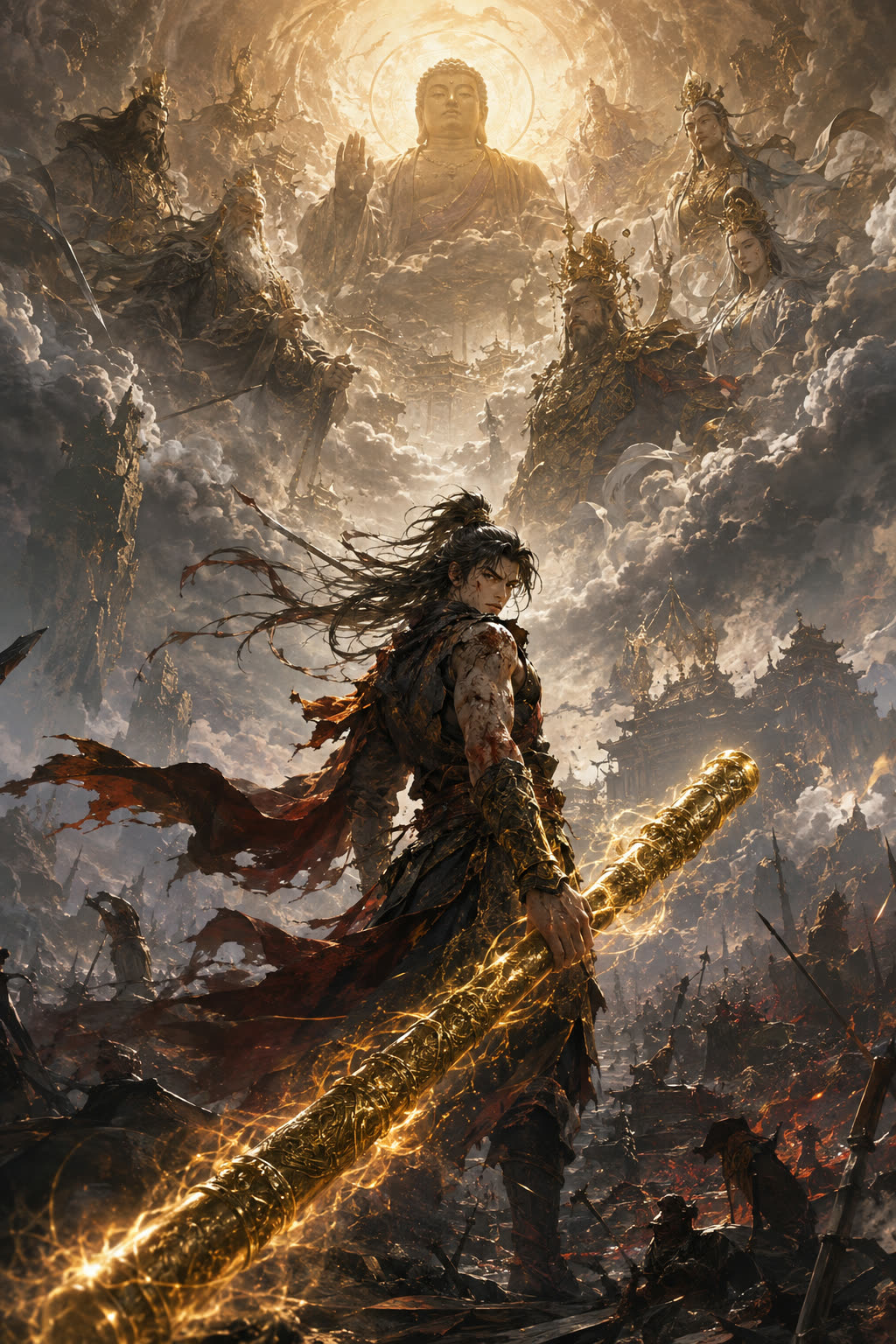
Wu Yu survives through a twist that defines the whole story. An old caretaker named Sun Wudao presses a plain iron rod into his hands, and Wu Yu “dies” and wakes reborn with two legacies. One is the Ruyi Jingu Bang, the Monkey King’s golden cudgel, and the adamantine body technique of the Great Sage Equal to Heaven. The other is the “devour heaven” art that gives the book its title: Wu Yu can consume the power of what he kills. That second gift turns every enemy into fuel, and it sets him on a climb the heavens did not authorize.
The stage grows from a single kingdom into a stack of worlds. Wu Yu moves through the Tongtian Sword Sect and the Shushan sword cultivators, then the Yanhuang heartland and the Divine Capital, then the vast Beiming Empire. Each layer scales up the enemies and the stakes until the story leaves the mortal plane entirely. He enters the Immortal Dragon Emperor Realm, the Demon God worlds, and finally the Immortal Domain and the Heavenly Court itself, where the real pantheon of Journey to the West walks the page: the Jade Emperor, Erlang, Subodhi, Guanyin, Taishang Laojun, and the Buddha.
What makes the book tick is Wu Yu’s refusal to accept the rules handed down by the immortals. The opening line of the story declares that he will set the heavenly laws himself, and the immortals and Buddhas come to see him as a world-devouring demon even as mortals hail him as their savior. Feng Qingyang builds a long, dense power fantasy on that contradiction: a hero who inherits the Monkey King’s rebellion and turns it into a cosmic ascent.
II. Highlights
The prince’s fall and rebirth
The first chapters frame Wu Yu’s betrayal with real weight, then pay it off when the iron rod becomes the golden cudgel and the Great Sage’s body technique wakes inside him. The moment he rises from his own grave sets the book’s defiant tone. - The devour-heaven mechanic. Wu Yu’s ability to consume his enemies’ strength turns combat into accumulation. It is the engine that pushes him past rivals who should outclass him, and the source of the “demon” reputation that follows him to the top. - The sword-sect grind. Early volumes in the Tongtian and Shushan sects deliver the cleanest cultivation beats: a disgraced outsider climbing by raw will while immortals treat servants like insects. The class resentment sharpens every win. - The Heavenly Court reckoning. In the closing arc Wu Yu storms the real Heavenly Court and faces the Buddha’s own designs. The book closes the loop on its Monkey King homage by making its hero the one who rewrites the heavens.
IV
Should you read it?
Reasons to read
- You like Journey to the West and want to see its pantheon rebuilt inside a cultivation climb.
- The devour-and-grow mechanic keeps every fight consequential.
- The underdog-to-rebel arc stays consistent from kingdom to heaven.
- Western readers who know Chinese myth only through the Monkey King will find familiar ground here, rebuilt as a cultivation epic. The book opens on Wu Yu, crown prince of the mortal Dongyue Wu Kingdom, a born soldier prodigy poised to take the throne. A corrupt "protective immortal" frames him for a crime against his father's concubine, strips his cultivation…
Reasons not to read
- The length is punishing, and the middle volumes repeat the same ascent pattern.
- Romance and side characters stay thinner than the power curve.
- The mythic names assume some comfort with Chinese cosmology.
- The imported guide still needs a final editorial pass.
Who it fits
- Fans of mythic xianxia and system-free progression who enjoyed titles like The Legend of the Broken Sword or I Shall Seal the Heavens.
- Good for readers who want a long, rebellious climb with a recognizable legendary engine under the hood.
- Readers exploring Chinese web fiction.
- Good for readers who want a long, rebellious climb with a recognizable legendary engine under the hood.
- Readers looking for a different reading experience.
Reader community
Would you recommend it?
Register or sign in to recommend this novel and comment.
Reader comments
0 comments