I. Overview
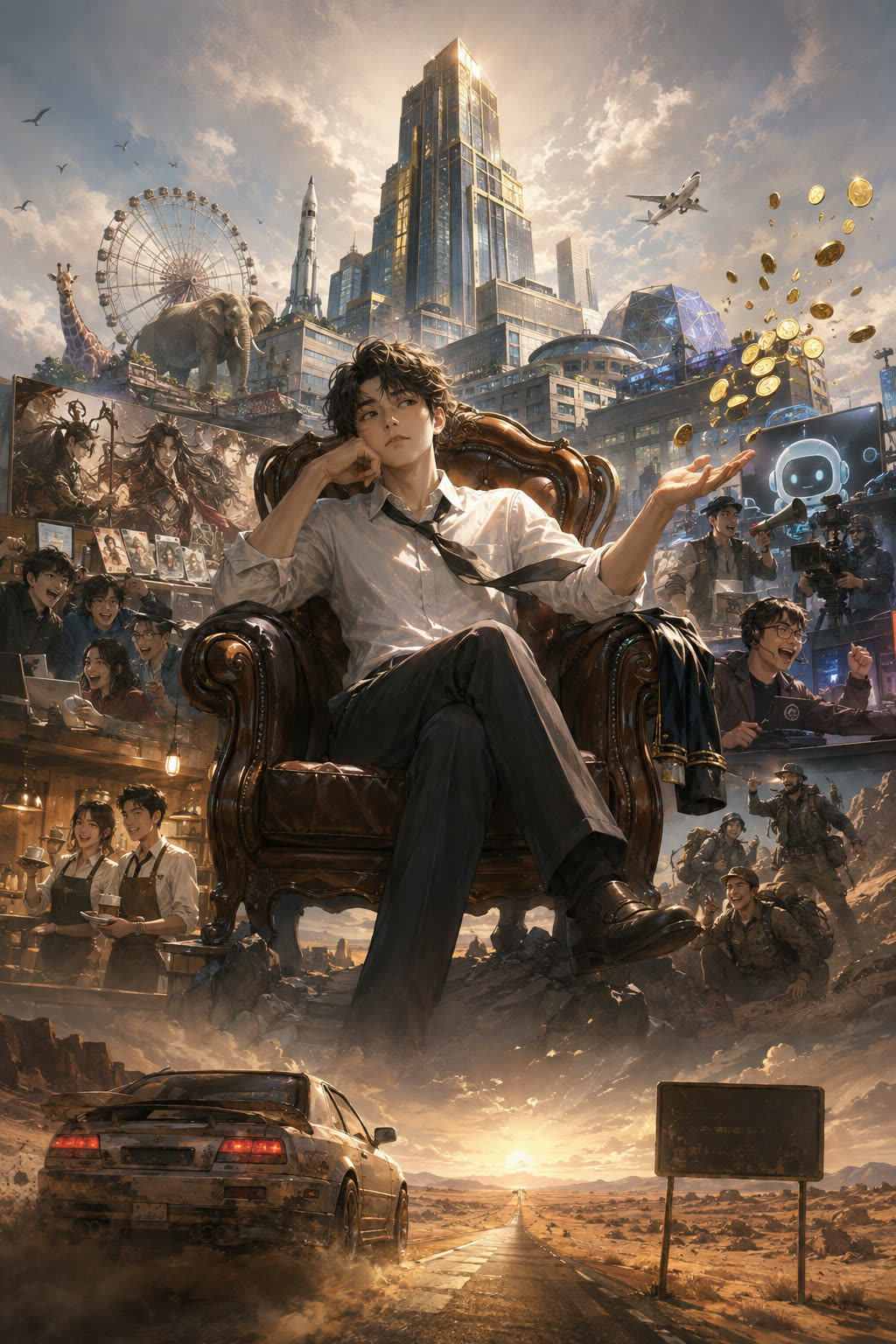
Most system novels hand the hero a cheat that rewards winning. This one pays him to lose. A system reboots Pei Qian a decade into the past and binds him to a Wealth Conversion System: it turns company losses into his personal cash at a one-to-one rate, but profits only at a hundred-to-one rate. His only mission is to run a business into the ground and walk away rich. He opens with a terrible driving game, eight hours of empty desert highway with no pause button and a sign at the end that mocks anyone who finishes. The trick at the core is simple: every sabotage he plants blooms into a hit.
The opening stays grounded and absurd. Pei Qian founds Tengda with a modest startup fund and sets out to flush it down the toilet. He commissions an unwinnable card game under a brief written by his game-illiterate roommate, then opens a chain of cafes and an internet cafe where staff get paid to slack. Each scheme to bleed money instead hires real talent, pleases real customers, and builds a real brand. His employees read his panic as deep strategy and weave it into something they call the Tengda Spirit.
The world widens by layers: from a dorm-room studio to a game publisher, then to internet cafes, restaurants, a film studio, a web-novel platform, a phone maker, fitness clubs, an esports league, VR labs, an AI assistant, a logistics network, a live-streaming site, a zoo, and a headquarters tower, every fresh failure-proof venture becoming another beloved Tengda subsidiary that the market rewards against his wishes.
The story runs on two engines, deadpan comedic irony and a quiet critique of grind culture. Pei Qian never wanted a throne; the finale leaves it empty as he chooses to keep his own heart over the empire he built by accident. His loyal, permanently deluded staff, Ma Yang, Lin Wan, Bao Xu, and the streamer Qiao Laoshi, give the farce its warmth. It runs long, but it earns its laughs by mocking the very hustle it depicts.
II. Highlights
The eight-hour desert
Pei Qian builds Lonely Desert Highway as a prank: drive a car down a single desert road for eight real-time hours, no save, no pause, and a black screen at the end that reads “Congratulations, you wasted eight hours of your life.” Streamer Qiao Laoshi takes the challenge live, rages through all eight hours, and posts the footage. The video blows up, drags thousands of curious players to the store, and Pei Qian watches his clean loss melt into profit.
The reverse art brief
For his card game Ghost General, Pei Qian tells the artist to avoid the cute style, hands the character brief to his clueless roommate Ma Yang, and pays well with zero pressure. The artist reads the freedom as trust and delivers gorgeous ink-style art. The game sells out. Pei Qian’s sabotage becomes the studio’s flagship.
Suffering Tours
Bao Xu launches a travel company that marches Tengda’s own managers into brutal wilderness treks, led by a retired special-forces handler told to show no mercy. Pei Qian loves the plan because it burns cash and annoys his overachieving staff. The managers come back tougher and more devoted than before.
The empty throne
Facing the system’s final choice, Pei Qian picks the loss-conversion path so he will not become the monster he fights, sets up a supervisor board, and walks away. The empire stands without him. The seat stays open.
IV
Should you read it?
Reasons to read
- An original comic engine. Most system stories reward the win; this one rewards the loss, and the inversion keeps paying off for the whole run.
- Sharp satire of hustle culture. Tengda's no-overtime, high-pay, paid-slacking rules read like a worker's daydream aimed straight at burnout.
- Pei Qian is a rare lead who advances by panicking. His deadpan suffering makes each chapter a small, bright joke.
- Most system novels hand the hero a cheat that rewards winning. This one pays him to lose. A system reboots Pei Qian a decade into the past and binds him to a Wealth Conversion System: it turns company losses into his personal cash at a one-to-one rate, but profits only at a hundred-to-one rate. His only mission is to run…
Reasons not to read
- It runs enormous, and the central gag repeats for hundreds of chapters; readers who want a tight plot will feel the length.
- There is no romance and almost no stakes beyond the comedy; readers hunting for heart-pounding drama will bounce off.
- The satire targets Chinese platform and office culture; some jabs land harder if you know the industry, but none require homework.
- The imported guide still needs a final editorial pass.
Who it fits
- Fans of dry workplace comedy and satirical capitalism stories who like a lead that loses on purpose.
- Readers who would pair The Office with a business simulator and laugh at both.
- Conversely, if you need romance, dark stakes, or a fast single-track plot, this book probably is not your taste.
- Readers exploring Chinese web fiction.
- Readers who would pair The Office with a business simulator and laugh at both.
- Conversely, if you need romance, dark stakes, or a fast single-track plot, this book probably is not your taste.
- Readers looking for a different reading experience.
Reader community
Would you recommend it?
Register or sign in to recommend this novel and comment.
Reader comments
0 comments