I. Overview
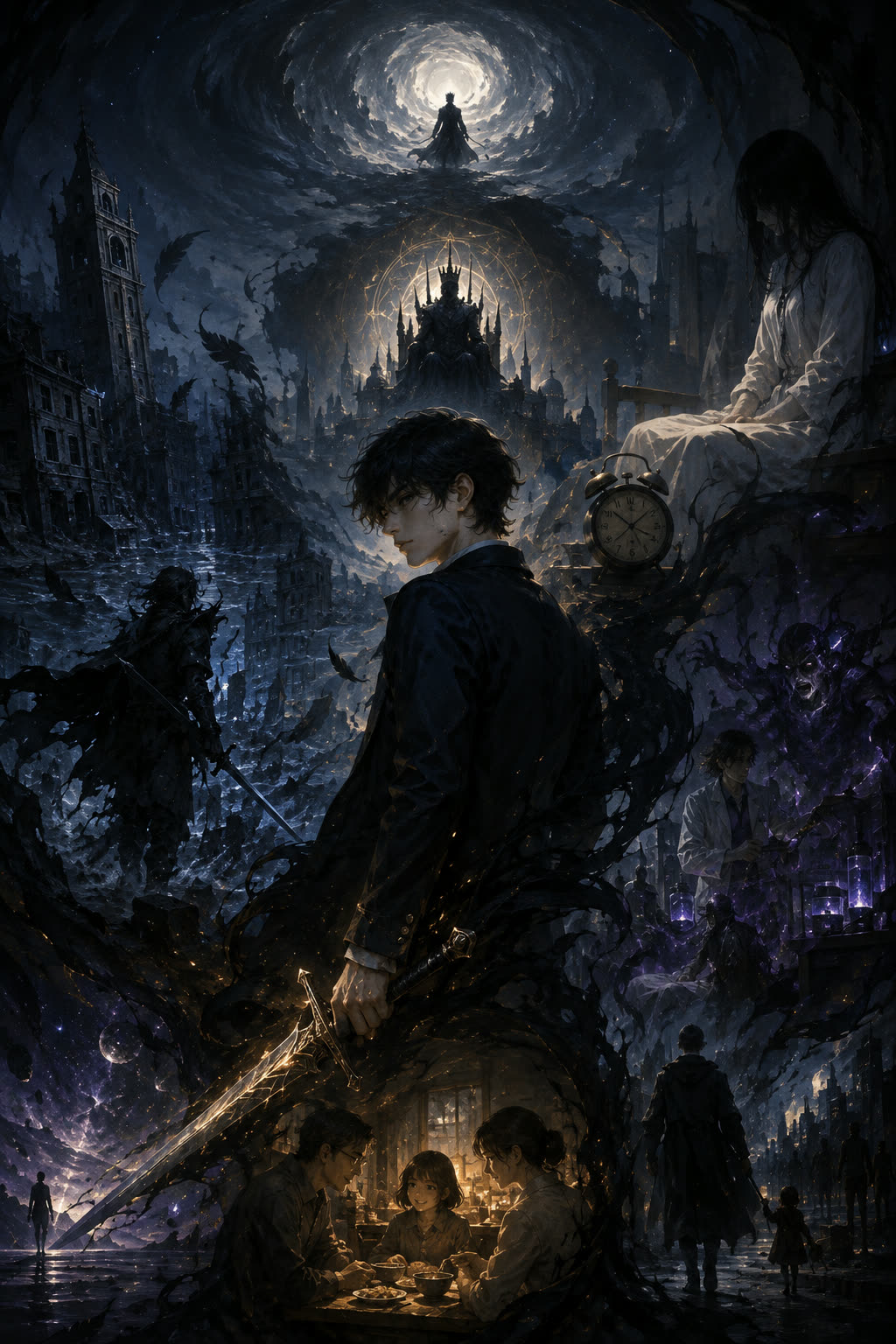
Nightmare’s Call takes one of horror’s oldest setups, a teenager who cannot stop having the same bad dream, and bolts a progression engine onto it. Lin Sheng is a senior-year student in a parallel world still running on cassette tapes and flip phones, the son of a shopkeeper in a household counting every bill. He carries the memories of a previous life, wants almost nothing, and keeps his head because panic wastes time. Then the dream begins. A woman in white sits at his desk. Footsteps come down the hall, closer every night, and something cold closes on his ankles. He answers like an engineer: he times the dream against an alarm clock, logs the intervals, and hunts for the one point where he can still move.
The early going runs on method. Lin Sheng breaks the paralysis, tears open a crack in the dream-kitchen wall, and drops into Black Feather City, a drowned ruin of European-looking streets where fear-eaters pick through the wreckage. He kills a rotting swordsman, swallows the dead man’s memories, and wakes with a decade of blade work already in his hands. Notebooks left by a dead imperial fencer, in a language he teaches himself from a bootleg dictionary, supply the rest. Every kill pays him three ways: memories, soul fragments, and holy power that burns corruption on contact. Soon he stops going in alone and drags out what he has killed, including a washed-up assassin lord who would sooner nap than draw.
From there the floor keeps falling out from under him. A school desk in a poor district gives way to the ruin, then to his own world’s underside of people powered by their own corrosive emotions, then a university city where he funds a lab and clones fiend cells to see how the power rots them. Cities go under the Black Tide. He builds a church into the last wall humanity has and lets himself be crowned emperor of it. Then the story leaves his world: an elf dungeon built to strip bloodlines out of prisoners, a mage grove where casting runs on a goddess’s Weave with spell slots he refuses, a broken chatroom where cosmic predators trade taunts across universes, and at last the empty space outside everything, where he rewrites the rule that says nothing may be transcendent.
Two things hold it together. Lin Sheng never wins on talent, only on measurement, patience, and a willingness to cut. And the scale never buries the reason he started: he moves his parents and his sister inside the church walls, and the sister who used to nag him about making friends is the one who asks whether carrying everyone’s hope is exhausting. The Night King, the Steel King, and an indefinite number of copies of one maddeningly cheerful handmaiden keep it from turning grim for grim’s sake. He finishes outside the edge of everything, building a river out of the souls of the dead so the people he cares about have somewhere left to exist, then stands there with nothing in particular left to do.
II. Highlights
The footsteps in the hall
Lin Sheng lies frozen on his back with a woman in a white dress at his desk and something walking toward the bed. He cannot move, cannot blink, cannot shout. Night after night the footsteps get one step closer, so he starts treating the dream as a problem with variables. He sets an alarm, records how long the sequence runs, and isolates the moment where the thing at the foot of the bed reaches for the blanket. On the night he finally moves, he lunges, grabs the woman by the shoulder, and she deflates like a punctured skin, dress and all, then melts into nothing on the floor. Inside three nights the terror has become data, and that is the move the rest of the book keeps making.
The skinny kid at the fencing meet
Back in his own world he has cobbled together a small fencing club, and a regional amateur tournament is the first time anyone outside the dream sees what he can do. A heavyweight twice his size swings hard, Lin Sheng angles his blade, and the big man’s own strength levers his sword straight back into his faceguard. He ends the local favorite’s bout in two exchanges, then turns down the rich kid’s job offer, twice, because he intends to build something of his own. Nothing after this stays that small.
A letter from the underworld
Late in the book he is the Holy Emperor, standing in a watchtower over a city that only barely held. A black envelope drifts in from outside the walls with his title stamped on it in gold. He purges the thing trying to crawl into his hand, tears it open, and a face forms out of the smoke: the lord of the Hall of Malicious Spirits, offering to split the human world and the underworld between them and stay out of each other’s way. Lin Sheng reads it, laughs, and goes home to check on his mother.
The ice cream
Past the point where he can reverse local time or mint real currency out of nothing, Lin Sheng watches a woman he once handed a cultivation method to live her whole life, grow old, and dissolve into the sea of souls he can no longer hold together. Later, on a street two centuries on, he buys a vanilla cone, eats it in front of a hungry boy who was standing there waiting for someone to hand him one, tells him that waiting gets you nothing and that the only person he can rely on is himself, and presses the method into his hands. Then he walks off.
IV
Should you read it?
Reasons to read
- The protagonist earns everything by method. He times the nightmare with an alarm clock, catalogs what he learns, funds a lab to test his own power source, and grinds through a full curriculum of prerequisite subjects so he can bypass a spell-slot system he does not like. If you have wanted a progression hero who actually does the homework, he is your man.
- Get Lost builds dread better than most writers working in English. The opening stretch, with the woman in white and the footsteps, lands as real horror before the book grows into a power fantasy.
- The scope ladder is audacious. It runs from a high-school bedroom to the space between clusters of universes and still stops to check on his mother.
- Nightmare's Call takes one of horror's oldest setups, a teenager who cannot stop having the same bad dream, and bolts a progression engine onto it. Lin Sheng is a senior-year student in a parallel world still running on cassette tapes and flip phones, the son of a shopkeeper in a household counting every bill. He carries the memories of a…
Reasons not to read
- Once he outscales the physical, the fights stop reading as fights. Late conflicts turn into contests over which side can rewrite more of the underlying law, and the stakes get hard to feel.
- The middle repeats itself. Dive into a ruined world, kill, absorb, consolidate, negotiate, dive again. It moves, but you will recognize the shape.
- No romance, and very little interiority for anyone besides Lin Sheng. Side characters get a beat and then get outscaled.
- English availability is uneven. Confirm a translation covers the whole book before you commit, since the terminology carries a lot of the weight.
Who it fits
- Readers who liked the systems and cosmic dread of Lord of the Mysteries but wanted more progression payoff per chapter;
- fans of ruthless, calculus-first leads in the Reverend Insanity mold who prefer a protagonist that plans to one that postures;
- anyone who enjoys watching a magic system get taken apart and rebuilt.
- It is not for readers who need relationships to carry a long book, who want romance, or who bounce off power inflation.
- fans of ruthless, calculus-first leads in the Reverend Insanity mold who prefer a protagonist that plans to one that postures;
- anyone who enjoys watching a magic system get taken apart and rebuilt.
- It is not for readers who need relationships to carry a long book, who want romance, or who bounce off power inflation.
- Readers looking for a different reading experience.
Reader community
Would you recommend it?
Register or sign in to recommend this novel and comment.
Reader comments
0 comments