I. Overview
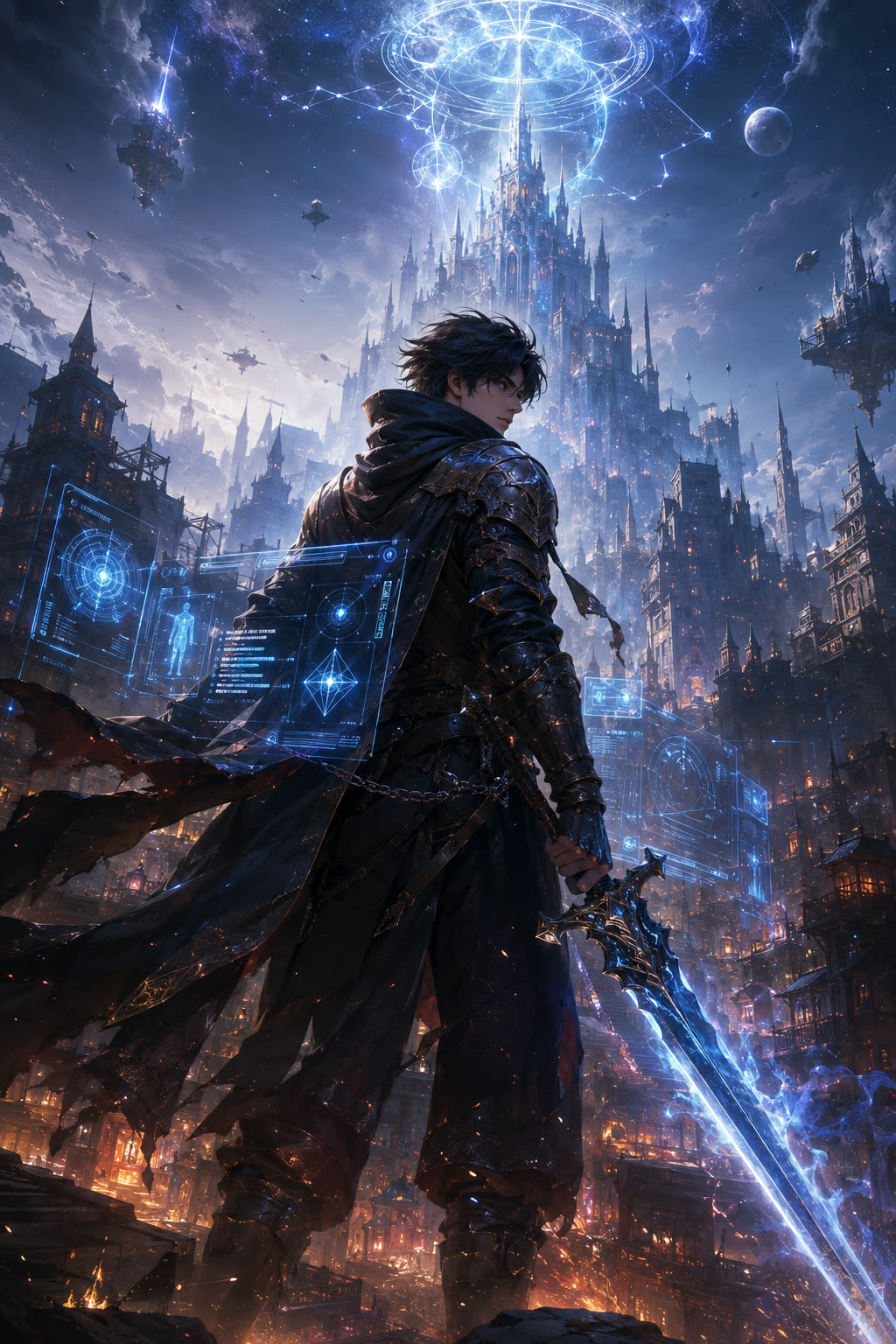
Paradise of Demonic Gods is Bear Wolfdog at his most mechanical: a LitRPG skin stretched over a wuxia spine and then cranked past the speed of light. In 2035 a blast over Benhai City fused an otherworld with Earth, and the overlap zone became the Demon Capital, where physics quit and everything turned to numbers. People gain levels, five combat stats, skills, and job classes. Fang Xingjian, sixteen years old and a level-nine Warrior Servant, grows up inside that datafied city and learns early that the system rewards those who grind and punishes those who won’t.
The opening is cold and domestic. Fang Xingjian belongs to one of the five great families, but his grandmother loathes him and plans to bind him as the “apostle” of his wizard-gifted younger brother, a living shield who eats every wound the brother takes. He runs, helped by an uncle and a police friend, then gets caught and tortured by a rival house that wants his family broken. A violet flame in his dreams keeps asking what he wants, and his answer, raw power, becomes the engine of everything after. The book never lets him forget that question; every climb traces back to a boy who refused to be someone’s shadow.
The world widens in hard rings. The Demon Capital opens into the otherworld’s knight academies, tournaments, and the Truth Church’s saint mountains; then into empires, wizard kings, and desert theocracies with their own god-realms; then the veil tears and the scale jumps to godhood, parallel Earths, star fleets, black holes, and shifting timelines. Fang Xingjian moves from a street-level runner to a continent-breaker to a being who weighs whole planets in his palm, and the mechanics stay consistent the entire way, every new tier built on the last.
The book’s loudest trait is method. Fang Xingjian treats cultivation like a science: he buys the right bones, names his sword, stacks specialities, and bends space and time because the math says he can. Romance stays thin and the humor drier still, so the warmth comes from rivalry and mentorship rather than love. It reads as a power fantasy with a ruthless, patient core, a long climb that rewards readers who like watching a system get solved instead of survived.
II. Highlights
The apostle who said no
In the family shrine, the old matriarch offers Fang Xingjian a choice that isn’t one: become his brother’s bound apostle, a witch-slave who absorbs every blow meant for the gifted boy. She slaps him when he refuses and pins him with a god-level palm. He crawls out of the shrine and runs into the night, sworn to return and prove her wrong. The scene sets the whole cold, merit-based tone in one blow.
Torture on the black boat
Caroline Onassis, of the rival Onassis house, keeps Fang Xingjian on a drifting ship and peels pieces off him while she laughs, certain his grandmother won’t pay a copper to save him. She spills the truth that his uncle freed him for a reason of his own, and that his mother’s death is no accident. The violet flame in his dreams drinks it all in. Nothing about this stretch is safe, and it hardens the hero before he ever levels up for real.
One palm ends a king
Years later, Fang Xingjian walks alone into a desert capital to settle a grudge and meets the Sand King’s full army. He steps forward, four sword intents circling his palm, and the Sand King’s body comes apart mid-spell. The city’s protective array buckles under his Zhuxian Sword Formation while the crowd screams for his blood. A single move flattens a nation’s pride, and the book shows exactly why.
The other shore slips away
At the end, the sects gather to reforge the Gate of Creation and cross to the Other Shore, and a nine-level god named Star Plucking Superior tries to bend them all to his will. Fang Xingjian drops five combat projections, each carrying force enough to crack a planet, pins the man inside stretched space, and casually resets the board. The chapter title is “Beginning.” The grind that started in a courtyard now decides the fate of worlds.
IV
Should you read it?
Reasons to read
- Few Chinese web novels build a system this rigorously. Watching Fang Xingjian optimize stats, swords, and space itself satisfies the same itch as a great game design, and the rules never break.
- The scale ambition is rare. The story hands you a street kid and ends with timelines and creation gates, and it earns each step instead of teleporting there.
- Bear Wolfdog writes a hero who wins on study and nerve, a nice change from chosen-one whining.
- Paradise of Demonic Gods is Bear Wolfdog at his most mechanical: a LitRPG skin stretched over a wuxia spine and then cranked past the speed of light. In 2035 a blast over Benhai City fused an otherworld with Earth, and the overlap zone became the Demon Capital, where physics quit and everything turned to numbers. People gain levels, five combat…
Reasons not to read
- The numbers and repetition wear on readers who want prose and feeling; long stretches read like a spreadsheet with a plot attached.
- Romance and comedy barely register, so anyone hunting for heart or laughs will find the book thin.
- The later turn from Western-knight flavor into Eastern cosmic cosmology can feel like two books bolted together.
- The imported guide still needs a final editorial pass.
Who it fits
- System and LitRPG fans who love optimization, tier climbs, and consistent rules;
- readers who like a ruthless, patient protagonist and a long, earned ascent;
- anyone who wants a cultivation book that thinks like an engineer.
- Conversely, if you need emotional depth, steady humor, or a single coherent genre voice, this one will likely exhaust you.
- readers who like a ruthless, patient protagonist and a long, earned ascent;
- anyone who wants a cultivation book that thinks like an engineer.
- Conversely, if you need emotional depth, steady humor, or a single coherent genre voice, this one will likely exhaust you.
- Readers looking for a different reading experience.
Reader community
Would you recommend it?
Register or sign in to recommend this novel and comment.
Reader comments
0 comments