I. Overview
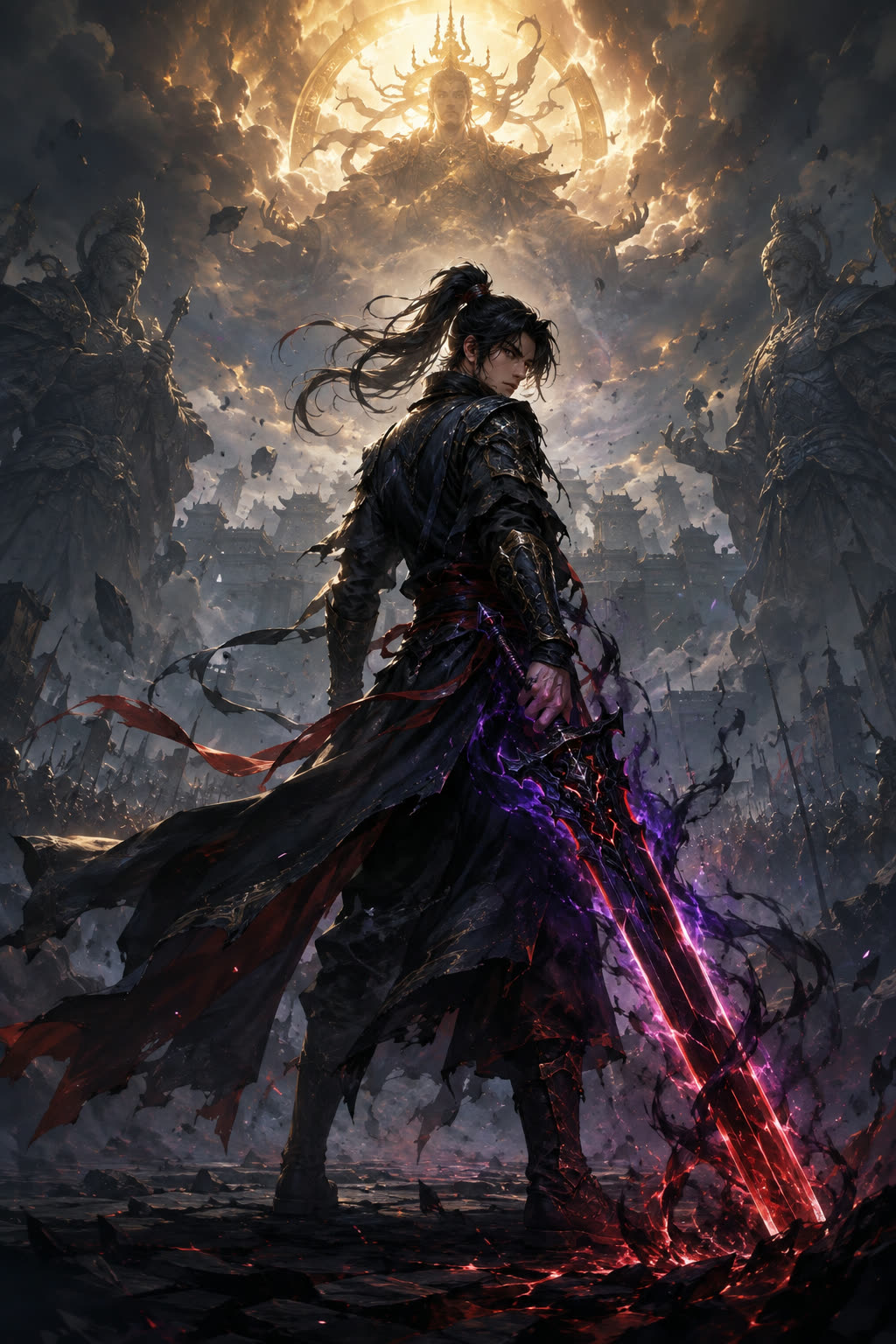
Peerless Martial God is a sprawling eastern power-fantasy, the Chinese web-novel answer to a lone underdog who climbs a mountain of stronger men and then kicks it down. Lin Feng opens as a modern college student who dies in a crash and wakes inside the body of a discarded “waste” heir in the Lin family, on a continent where martial cultivation rules everything and a person’s innate martial soul decides their worth. A freak soul fusion hands him a hidden dark martial soul alongside a second soul, and that stolen edge turns a nobody the whole clan laughs at into a threat they cannot ignore.
The early stretch is pure revenge and rise. Lin Feng walks back into the family hall, one-punches the cousin who mocked him as garbage, and rides that momentum straight out the gate toward the Cloud Sea Sect and a wider world of sects, tournaments, and blood feuds. His temper drives the plot: he answers every slight with a fight and every betrayal with a reckoning, and the book keeps building him bigger rooms to dominate.
The world widens by layers: from the Lin family courtyard and the snow-bound sects of the Xue Yue kingdom, up through the Eight Wastelands, the holy cities of the central plains, the ancient clans and emperor academies, then past the saintly and imperial ranks into a cosmos of god-temples and forbidden inheritances where Lin Feng trades blows with beings who treat whole nations as chess pieces.
Two words carry the book: defiant and relentless. Lin Feng never plays the humble genius; he provokes, he flaunts, he shields the few people he loves, and the bond with Mengqing and a handful of women gives the grinding climb a beating heart. The book runs long and repeats its chest-beating set pieces, but it delivers exactly what it promises: a nobody who refuses to kneel and carves his name across the heavens.
II. Highlights
The waste who punches back
In the Lin family hall, the elders and his uncles are already carving up his father’s seat, and his cousin Lin Yun calls him garbage to his face. Lin Feng walks up, issues a formal challenge, and floors Lin Yun with a single punch of layered force. The whole court goes silent. He turns to the uncle who sneered and asks, flatly, whether a man who calls someone waste just watched his own son lose to one. The chapter closes on his line: insult a man, and he will insult you back.
One man against three armies
Later, wearing a commander’s rank, Lin Feng tips a stalled war on its head. Enemies surround the city and expect a frightened heir; instead he rides out and cuts through their lines, his sword-light and forbidden arts dropping cultivators by the hundreds. The spine titles say it plainly: one man can destroy three armies. The thrill is the gap between how the enemy sees him and what he actually does to them.
The demon sword’s voice
A cursed blade follows Lin Feng for volumes, whispering when he bleeds and promising power for his rage. At his lowest, the sword nearly takes him, his eyes gone cold, friends forced to fight the thing he has become. He claws back from the edge, but the book never lets you forget the cost of that strength. Every time he draws it, someone he loves pays a price.
The god-temples’ ultimatum
At the end, the great temples surround Lin Feng because his forbidden blood scares them. Rather than kill him outright, they force a bargain: a duel in two years, his life and his entire Fate Temple staked on the result. Lin Feng agrees with a smile. The final pages leave the continents buzzing, every faction waiting for the war that will decide whether a mortal-raised upstart can stand against the gods themselves.
IV
Should you read it?
Reasons to read
- Few books deliver this pure a power curve. Watching a nobody who starts as family joke grind past princes, emperors, and finally gods is the whole addictive point.
- The defiance is the draw. Lin Feng provokes the strong instead of bowing, and the face-slapping, tournament, and war arcs hit hard for readers who like an unrepentant underdog.
- The scale is genuinely huge, and the later god-temple conflict gives the grind a real cosmic payoff.
- Peerless Martial God is a sprawling eastern power-fantasy, the Chinese web-novel answer to a lone underdog who climbs a mountain of stronger men and then kicks it down. Lin Feng opens as a modern college student who dies in a crash and wakes inside the body of a discarded "waste" heir in the Lin family, on a continent where martial…
Reasons not to read
- It is enormous and repetitive. The same "enter room, get insulted, win spectacularly" loop runs for thousands of chapters, and patience thins.
- The prose is functional, not literary. Western readers used to tight plotting may bounce off the padding and the endless power-posturing.
- Romance is thin and serviceable rather than earned.
- The imported guide still needs a final editorial pass.
Who it fits
- Readers who love progression fantasy, face-slapping revenge, and a hero who only climbs;
- fans of eastern cultivation who want a long, loud power trip from gutter to godhood;
- anyone happy to trade polish for sheer momentum.
- Conversely, if you need restraint, literary prose, or a quiet, morally grey hero, this book will exhaust you.
- fans of eastern cultivation who want a long, loud power trip from gutter to godhood;
- anyone happy to trade polish for sheer momentum.
- Conversely, if you need restraint, literary prose, or a quiet, morally grey hero, this book will exhaust you.
- Readers looking for a different reading experience.
Reader community
Would you recommend it?
Register or sign in to recommend this novel and comment.
Reader comments
0 comments