I. Overview
Su Ming starts life as the smallest boy in the Wu Shan tribe, a scrap of a child everyone pities because he lacks the barbarian body that lets a person cultivate. He gathers herbs, climbs cliffs for medicine, and watches stronger boys win the right to train as warriors. On the night of his sixteenth Barbarian Awakening rite, a black stone shard he wears at his neck flares to life, cracks the tribe’s idol, and hands him a cultivation method no outsider can teach. That shard turns a forgotten orphan into a threat the heavens were not built to contain.
The path climbs through Blood Coagulation, Dust Opening, Bone Sacrifice, and Barbarian Soul, each step paid for in blood and loss. Su Ming wins friends, loses them, and learns to fight across tribes and continents. Then the floor drops out. The tribe he loved, the grandfather who raised him, the memories he trusted, all of it was staged. An immortal named Di Tian built Su Ming’s entire world as a chessboard and placed him on it as a piece. Su Ming is not even who he thought: he is the last heir of a slaughtered clan, and his parents died shielding him from exactly this design.
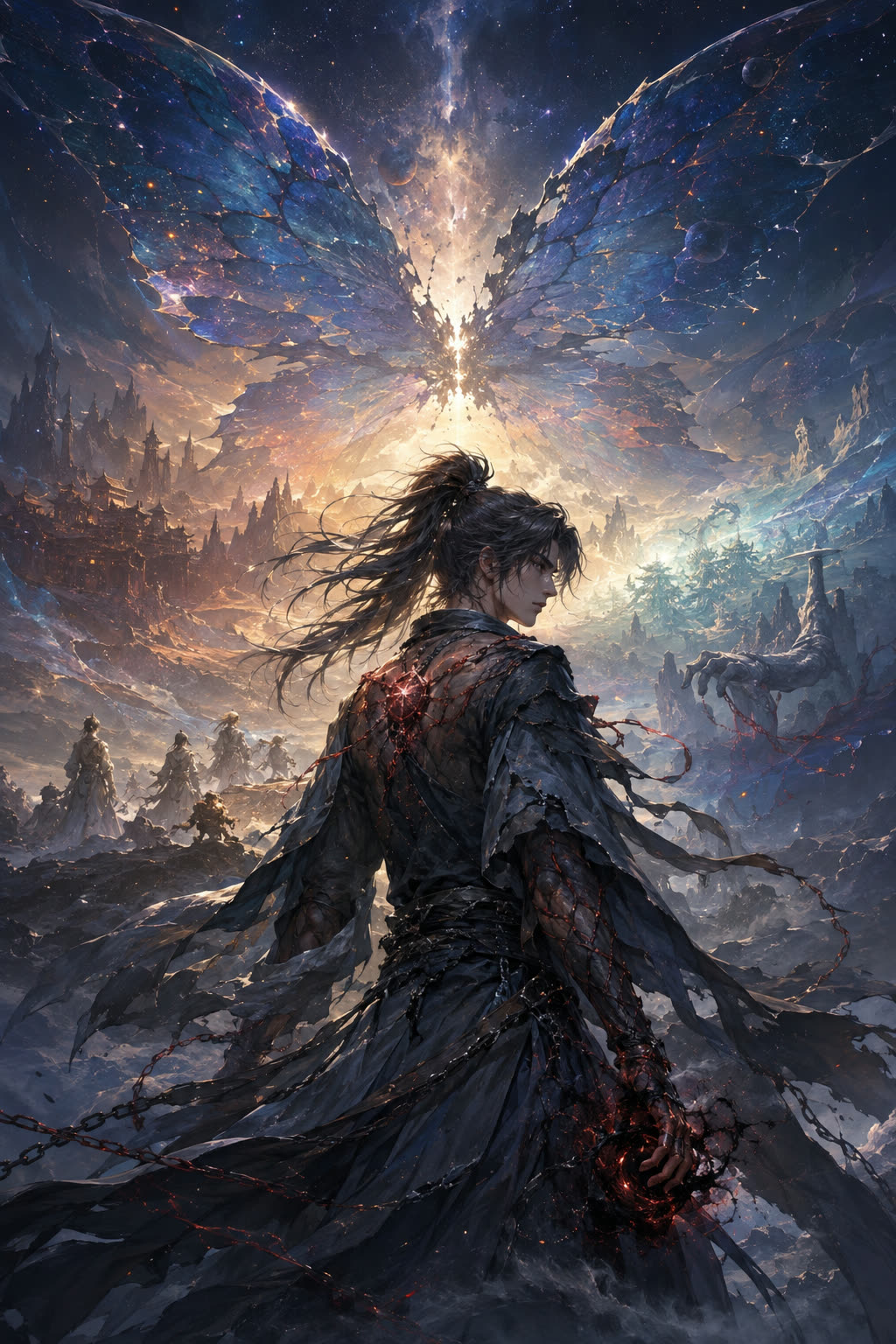
The stage blows open into something cosmic. The world itself is one wing of a vast butterfly-universe, and other wings hold other realms, other wars, other architects of fate. Su Ming travels from the Eastern Wasteland to the Divine Source Star Sea to the Dao Chen Sect, seizes an ancestral spirit, masters the craft of rewriting life and death, and is crowned the fourth-generation Barbarian God. He learns that “the devil” was never a villain. The word means a person who pursues the Dao with a will so stubborn the order of the cosmos breaks against it.
What lingers is the obsession underneath the power. Su Ming does not chase immortality or revenge. He chases a face he can barely remember, the one he knelt before the devil for three thousand years to keep. The book’s famous vow says it plain: look back on the mortal world and refuse to be a god, only wish to hold life and death in your hand for the one you love. In the end he spends his own cultivation and years to pull back everyone the world took from him, and the question the story leaves you with is whether any of it was real or just the shape of his grief.
II. Highlights
The awakening shard
At the rite, every other boy steps into the idol and fails or passes. Su Ming steps in and the idol cracks, because the black stone at his throat outranks the god his tribe worships. He walks out with a method no one can give him and a secret no one can take. The moment reads like a spark dropped on dry grass.
The world is a lie
Su Ming learns his happy childhood was a script, his grandfather a role, his tribe a set built to manufacture one specific weapon. The revelation does not free him. It breaks him, and the broken version is the one who starts bending fate instead of obeying it. Watching a kind boy become a man who reshapes reality to reclaim a stolen life is the engine of the whole book.
The butterfly and the Barbarian God
Later the camera pulls back until a single continent is just one wing of a dying butterfly-universe, and Su Ming stands at the center of a calamity that ends worlds. He takes the title of Barbarian God, fuses an ancestral will, and learns to write and erase existence. The scale flips from campfire to cosmology without losing the lonely boy at the middle of it.
I am the devil
When the world calls him a monster, Su Ming stops arguing. He claims the name. The closing vow, kneel before the devil and refuse the heavens to protect one person, turns the whole power climb into a love letter written in scars. It is the line readers tattoo on their memory.
IV
Should you read it?
Reasons to read
- You want cultivation where the prize is meaning, not just strength, and the cost is spelled out in people.
- The cosmology is genuinely strange, a butterfly universe of staged realities and stolen memories.
- Er Gen writes obsession better than almost anyone, and the ending lands like a punch.
- Su Ming starts life as the smallest boy in the Wu Shan tribe, a scrap of a child everyone pities because he lacks the barbarian body that lets a person cultivate. He gathers herbs, climbs cliffs for medicine, and watches stronger boys win the right to train as warriors. On the night of his sixteenth Barbarian Awakening rite, a black…
Reasons not to read
- The book is melancholy by design and stays there; happiness is temporary and expensive.
- Mid-volume fight scenes repeat, and the philosophy can outrun the plot.
- Loved ones die and stay dead, or return changed, which hurts by intention.
- The imported guide still needs a final editorial pass.
Who it fits
- Readers who finished Renegade Immortal or I Shall Seal the Heavens and wanted the sad one will find their book.
- Best for adults who like tragic, idea-driven fantasy and a hero who wins by refusing to let go.
- Readers exploring Chinese web fiction.
- Best for adults who like tragic, idea-driven fantasy and a hero who wins by refusing to let go.
- Readers looking for a different reading experience.
Reader community
Would you recommend it?
Register or sign in to recommend this novel and comment.
Reader comments
0 comments