I. Overview
Release That Witch is a nation-building fantasy that swaps the usual sword for the steam engine. Most cultivation and isekai stories send the hero off to fight with power he alone controls. Roland Wimbledon, a modern engineer reborn as the fourth prince of a medieval kingdom, wins by teaching people to build. The book’s hook is in the title: when the townsfolk drag a “witch” to the gallows, the new prince tears up the order and keeps her, because the women the church calls demons are the workforce his revolution needs.
The opening lands the premise with a jolt. Cheng Yan, an overworked drafter, wakes on a scaffold where a bound woman is about to hang for witchcraft. He dismisses the crowd, and the memory of his new body tells him he is Roland, a useless prince of Graycastle, posted to the poor Border Town. Instead of playing the role, he starts quietly rebuilding: he saves the witch Anna, learns her fire-shaping gift, and sees that a single trained mage can do the work of a foundry. The early chapters are a charming fish-out-of-water where modern common sense keeps outsmarting medieval fear.
The world widens from one town to a continent at war. Roland turns Border Town into a city of factories, schools, and firearms, absorbs witches fleeing the Church of Hermes, and builds an army that does not need heroes so much as engineers. Beneath the church’s hunts lies a deeper truth: the witches’ magic, the demonic invasions that come in cycles, and the “divine envoys” who rule from above are all part of a cosmic struggle between the world and the Void. The story climbs from plumbing and gunpowder to the nature of reality itself.
The book’s pulse is “practical and hopeful.” Roland is a manager more than a warrior, and his victories are bridges, laws, and loyal people rather than duels. Romance runs quiet but true, anchored by Anna, the first witch and his steady partner. What lingers is the rare pleasure of a power fantasy where the hero’s greatest weapon is letting others grow, and where progress feels like a gift to everyone, not just the chosen.
II. Highlights
The order torn in half
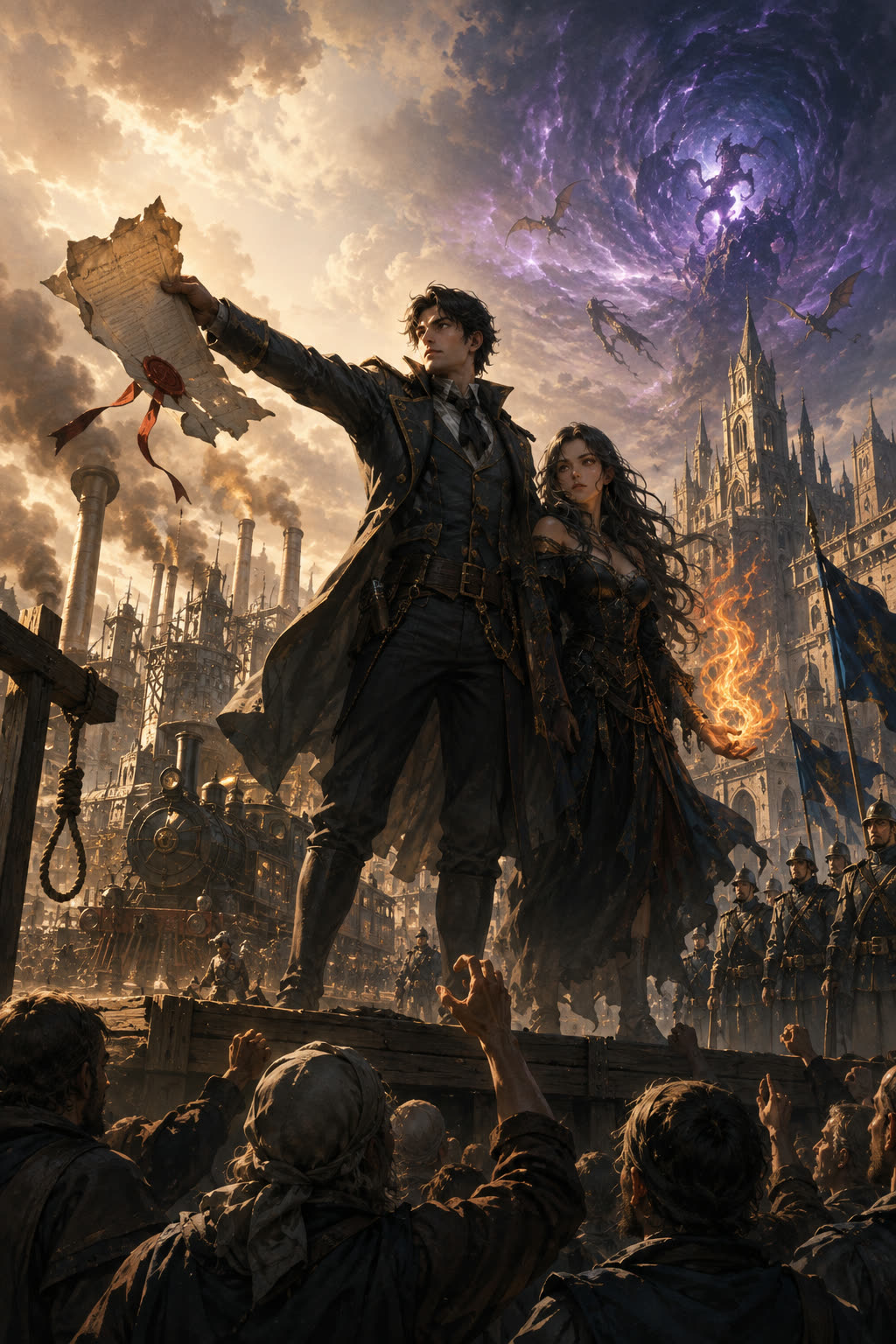
Roland faces a jeering crowd and a witch at the noose, and simply throws the execution writ on the ground. The moment sets the whole moral contract: he will not burn the people his world fears, he will employ them.
Anna at the forge
The first witch he spares bends flame into any shape she imagines. Watching Roland pair her gift with drafted blueprints to make steel and engines shows the book’s engine in one scene: magic as industry, not spectacle.
The church’s war machine
As Roland’s town modernizes, the Church of Hermes moves against him with witch-hunters and holy armies. The clashes pit his rifles and trenches against faith and fanaticism, and the question of who truly serves humanity gets asked without easy answers.
The envoys and the Void
Late in the story the veil lifts. The church, the demons, and the divine envoys are revealed as pieces of a larger war between the living world and a devouring Void. Roland’s hard-won civilization becomes the last line of defense, and the quiet builder turns out to have been preparing for the real enemy all along.
IV
Should you read it?
Reasons to read
- The premise is fresh for the genre. Watching an engineer rebuild a fantasy world with real science, and turn persecuted witches into a workforce, is genuinely original.
- The worldbuilding rewards patience. The slow reveal that magic, church, and demons are one cosmic system is a rare payoff in web fiction.
- Release That Witch is a nation-building fantasy that swaps the usual sword for the steam engine. Most cultivation and isekai stories send the hero off to fight with power he alone controls. Roland Wimbledon, a modern engineer reborn as the fourth prince of a medieval kingdom, wins by teaching people to build. The book's hook is in the title: when…
Reasons not to read
- The technical and administrative detail runs long; readers wanting constant action will find the nation-building dry at points.
- The cosmic late-game reframes earlier events heavily, which can feel like a gearshift if you came for the farming.
- The imported guide still needs a final editorial pass.
Who it fits
- Fans of nation-building, alternate-history, and "magic as technology" stories who like a smart, peaceful-leaning hero;
- readers who enjoy science-meets-fantasy worldbuilding with a slow, satisfying reveal;
- anyone tired of duel-centric power fantasy and looking for something constructive.
- Conversely, if you need nonstop fights, a brooding hero, or a large harem, this will feel too calm and technical.
- readers who enjoy science-meets-fantasy worldbuilding with a slow, satisfying reveal;
- anyone tired of duel-centric power fantasy and looking for something constructive.
- Conversely, if you need nonstop fights, a brooding hero, or a large harem, this will feel too calm and technical.
- Readers looking for a different reading experience.
Reader community
Would you recommend it?
Register or sign in to recommend this novel and comment.
Reader comments
0 comments