I. Overview
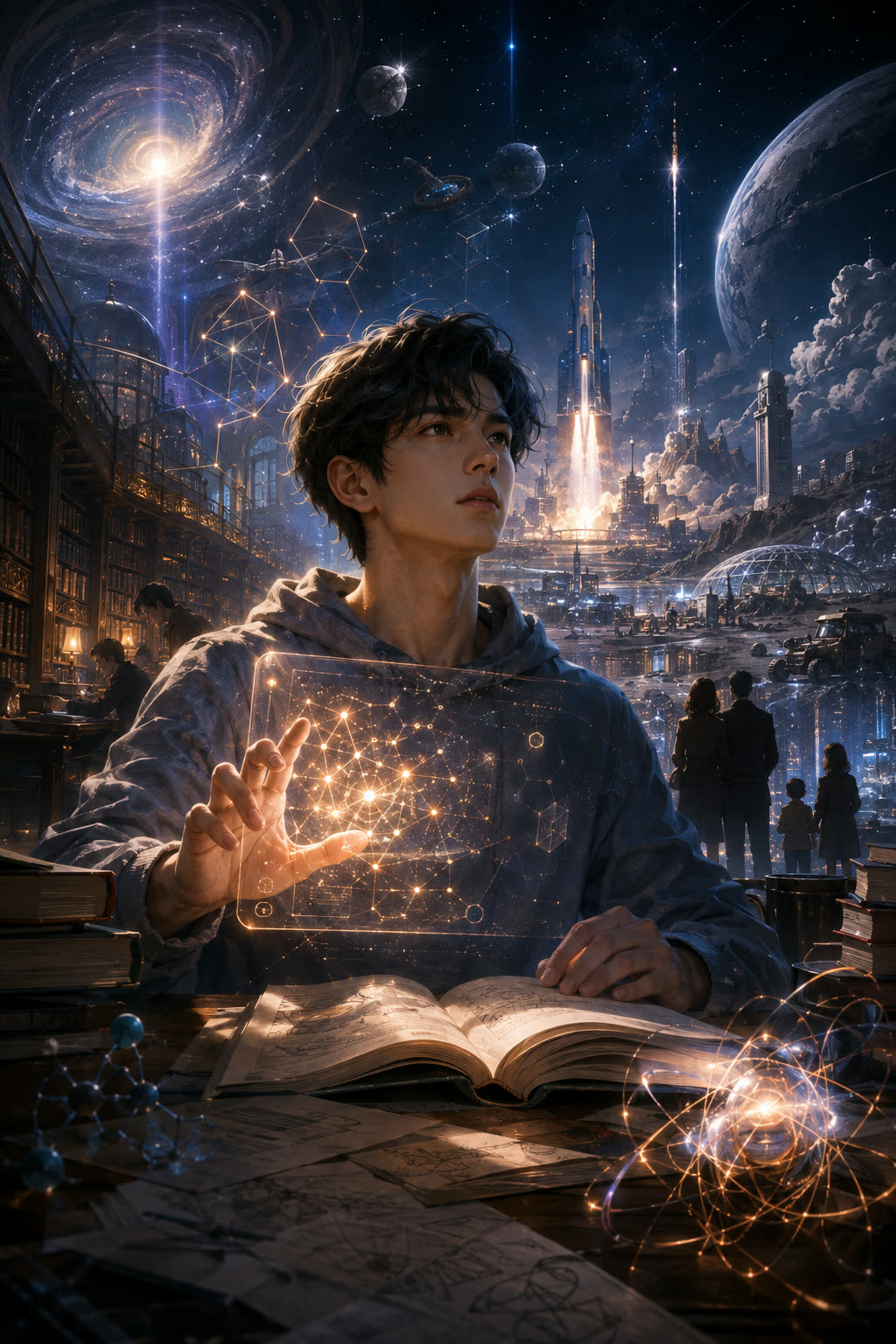
Lu Zhou is broke, tired, and one heatstroke away from quitting his costume mascot job outside a phone store. Then a translucent screen opens in his mind. A “Black Tech System” has chosen him, and it rewards real science with real power. Solve a hard problem, earn experience. Push a discipline to its limit, unlock the next. The panel lists mathematics as the root of everything else, which suits a Jinling University math major who had been doubting his own major.
The early chapters read like a campus comedy with stakes. Lu Zhou grinds through libraries, proves a long-unsolved conjecture to launch his academic career, and learns that the system pays best when the work actually moves the field forward. From there the novel turns into a climb that never stops. He attacks pure mathematics first, then physics, chemistry, materials, energy, and engineering, each level feeding the next as his papers start landing in the journals that matter.
What separates this book from a standard system fantasy is its grounding. The breakthroughs track a believable arc: better batteries, controlled nuclear fusion, carbon-based chips, quantum computers, then lunar bases, Mars colonies, and star gates. Lu Zhou builds companies, mentors students, and drags a reluctant world into a spacefaring age, racing rivals from other nations while the system keeps dangling harder problems. The story ends with humanity no longer bound to one planet.
Beneath the tech-tree progression runs a quieter theme. The system hints that it exists to lift a civilization’s level, and Lu Zhou keeps choosing the harder, kinder path: share the science, train the next generation, refuse to hoard the future. Morning Star LL writes wish-fulfillment with enough structure that the wish feels earned.
II. Highlights
The mascot who woke up to a system
Lu Zhou faints in a bear suit and opens his eyes inside a white void with a stat screen. The opening sells the premise in one scene: a poor student, a trivial job, and a power that rewards only genuine intellect.
The library where value has a number
Books glow with coefficients tuned to what Lu Zhou can still learn. He stops pretending to study and starts devouring mathematics, and the first proof he extracts from the system launches a career most researchers never reach.
Fusion and the moon base
Years in, Lu Zhou’s reactor finally ignites and his lunar project comes online. The book pays off its slow burn here, turning private ambition into a light that changes where humanity can live.
The century he missed
Late in the story Lu Zhou returns to a changed Earth and meets descendants of his own family. The moment reframes the whole grind: progress cost him time with the people he started out trying to support.
IV
Should you read it?
Reasons to read
- You love system stories where the power is intellect, not combat.
- You want a long, satisfying rise from nobody to the person who lifts civilization.
- You enjoy near-future science rendered as achievable steps rather than hand-waving.
- Lu Zhou is broke, tired, and one heatstroke away from quitting his costume mascot job outside a phone store. Then a translucent screen opens in his mind. A "Black Tech System" has chosen him, and it rewards real science with real power. Solve a hard problem, earn experience. Push a discipline to its limit, unlock the next. The panel lists…
Reasons not to read
- You dislike repetition; the level-up formula repeats across many disciplines.
- You want literary depth or moral ambiguity over a competent-hero fantasy.
- You prefer contained stories; this one sprawls across hundreds of chapters and decades.
- The imported guide still needs a final editorial pass.
Who it fits
- Readers who finished a textbook and imagined themselves changing the world.
- Best for fans of STEM-driven power fantasy, system genres, and "ordinary person becomes indispensable" arcs who don't mind a very long runway.
- Readers exploring Chinese web fiction.
- Best for fans of STEM-driven power fantasy, system genres, and "ordinary person becomes indispensable" arcs who don't mind a very long runway.
- Readers looking for a different reading experience.
Reader community
Would you recommend it?
Register or sign in to recommend this novel and comment.
Reader comments
0 comments