I. Overview
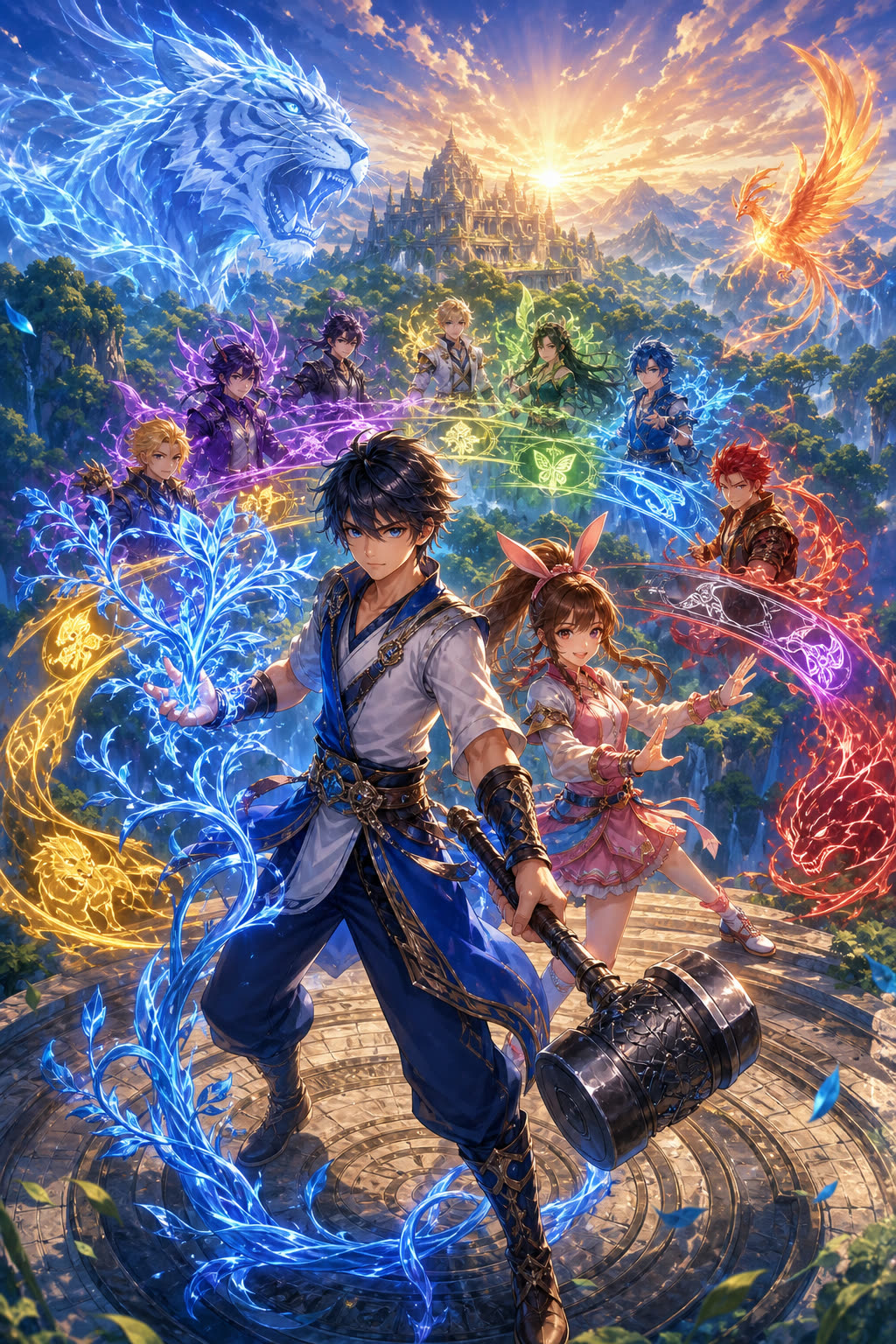
Soul Land is the book that pulled a whole generation of Western readers into Chinese web fiction, and the anime adaptations turned it into a household name. Picture a team-based shonen battle story built on a cultivation ladder, where friendship and a tight crew carry the hero as much as raw power. The lead, Tang San, was a master of hidden weapons in a martial-arts sect of another world. Caught stealing forbidden craft, he jumps off a cliff to die and wakes up as a boy in a land where every child awakens a martial soul at age six. His edge is unfair: twin martial souls, a plain Blue Silver Grass nobody respects and the legendary Clear Sky Hammer, plus a reincarnated assassin’s memory of poisons, footwork, and mechanical darts no one in this world has seen.
The book opens small and poor. In a backwater village Tang San’s awakening declares his grass a trash soul, yet he tests at innate full soul power, the rarest start there is. He leaves for academy, meets Xiao Wu, a rabbit-eared girl who fights like a storm, and joins a band of misfits who become the Shrek Seven Monsters under a strict teacher called the Grandmaster. The early arcs are tournaments, forest hunts for spirit rings, and the slow proof that his “weak” grass controls the whole field.
The stage widens by rings. It moves from Holy Soul Village and the schools of the Tian Dou Empire to the Continental Elite Tournament against royal and elemental academies, then drops into the Slaughter City where Tang San earns a killing domain, climbs to Sea God Island for nine divine trials, and ends at the god war above Jialing Pass against the Spirit Empire and its two goddesses. Each step adds a new color of power, from thousand-year rings to red hundred-thousand-year rings to godhood itself.
The book beats because it is an ensemble, not a lone climb. Tang San wins through loyalty, preparation, and the Seven Monsters fighting as one, and the heart that anchors everything is Xiao Wu, the girl who gives her life to save him and waits for him to bring her back. Read it for the found-family warmth and the clean thrill of a soul rank rising from one to ninety-nine.
II. Highlights
The awakening that breaks the rules
At the village ceremony, the examiner sees Blue Silver Grass, the textbook trash soul, and waves Tang San off. Then the test crystal blazes: innate full soul power. The man who expected nothing stares at a monster, and the reader knows the grass is a lie hiding a far larger destiny. The scene sets the whole con of the opening.
Xiao Wu gives everything
Deep in a beast forest, Tang San’s enemies learn the truth he has hidden: Xiao Wu is a hundred-thousand-year spirit rabbit walking as a girl. To save him she offers her own body as a spirit ring, a sacrifice that nearly ends her. The moment turns a playful companion into the emotional spine of the book, and Tang San spends volumes earning her back.
The Sea God’s heavy gift
On Sea God Island, Tang San faces the trident buried in the seabed and must lift a weapon that weighs more than a mountain. He pulls it with everything he has, survives the trial, and steps onto the path of a god. The test reads as pure earned spectacle, the kind of set piece the book does best.
The god war at Jialing Pass
At the end, Tang San returns as the Sea God to face Qian Renxue the Angel God and her mother Bibi Dong the Rakshasa God. He throws the Buddha’s Fury Tang Lotus, breaks his own rings for one final strike, and protects his father and friends in a sky-wide duel. After a thousand chapters of climb, the underdog crew finally wins the continent.
IV
Should you read it?
Reasons to read
- It is the smoothest on-ramp into Chinese web novels for a Western reader, with clear rules and a cast that explains the system as it goes.
- The ensemble and the Tang San-Xiao Wu romance give the grind real feeling, rare in lone-wolf cultivation stories.
- The power curve is pure satisfaction: watch a trash-soul boy take every rank to godhood through cleverness, not just brute force.
- Soul Land is the book that pulled a whole generation of Western readers into Chinese web fiction, and the anime adaptations turned it into a household name. Picture a team-based shonen battle story built on a cultivation ladder, where friendship and a tight crew carry the hero as much as raw power. The lead, Tang San, was a master of…
Reasons not to read
- The book is long and the middle sags through repeated tournament and trial arcs that test patience.
- The tone leans young adult and the power-of-friendship beats can feel saccharine to readers wanting grit.
- Early fan translations vary in quality, and the prose favors function over literary polish.
- The imported guide still needs a final editorial pass.
Who it fits
- Fans of shonen team stories who like watching a crew grow up and win together.
- Readers who want progression with a strong love story at the center.
- Anyone curious where the Chinese web novel boom began. If you need mature darkness, tight plotting, or subtle prose, this one will likely feel too sweet.
- Readers exploring Chinese web fiction.
- Readers who want progression with a strong love story at the center.
- Anyone curious where the Chinese web novel boom began. If you need mature darkness, tight plotting, or subtle prose, this one will likely feel too sweet.
- Readers looking for a different reading experience.
Reader community
Would you recommend it?
Register or sign in to recommend this novel and comment.
Reader comments
0 comments