I. Overview
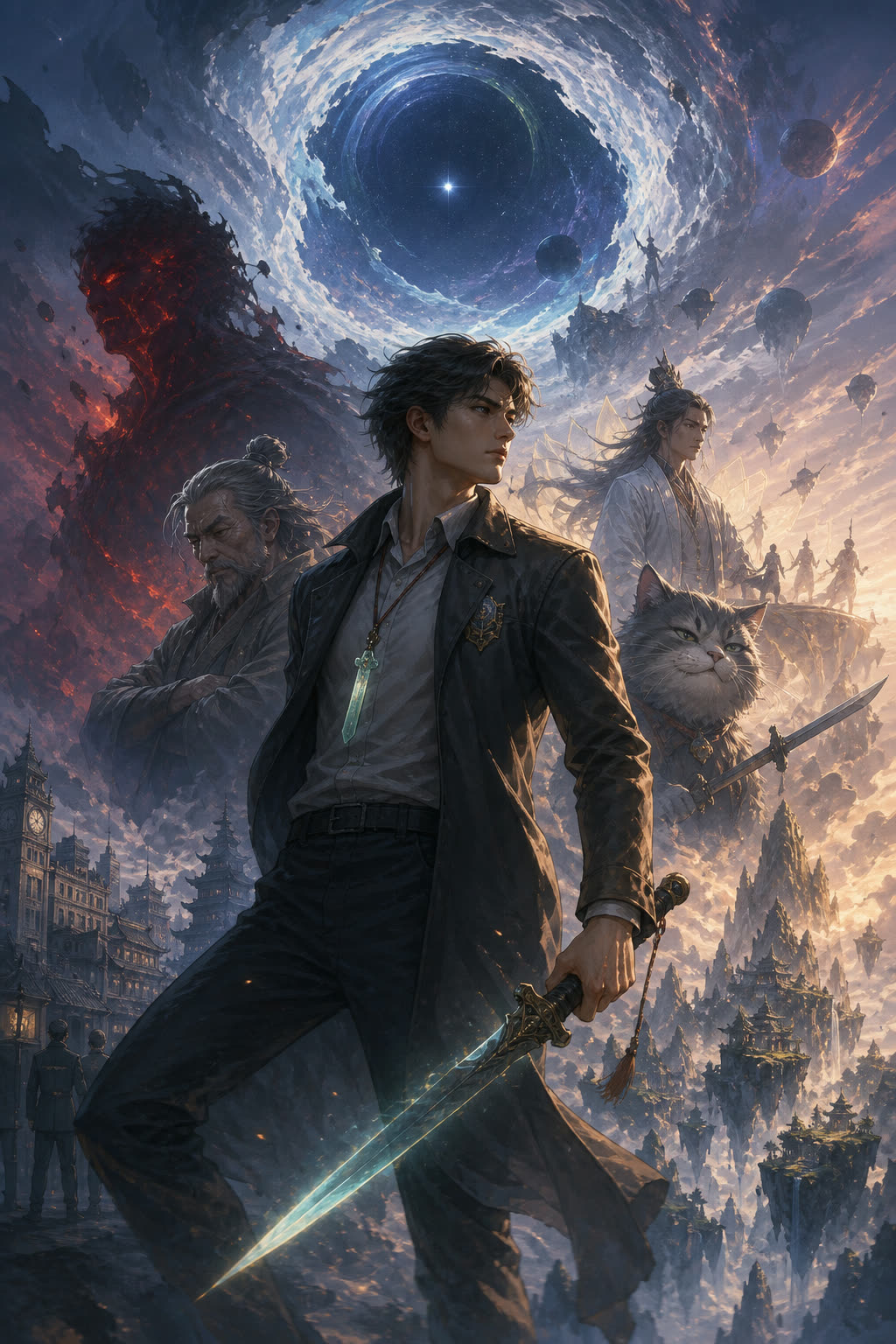
Star Gate drops a “super-energy” evolution system into a small-city law-enforcement bureau and builds a classical martial-way epic on top of it. Li Hao works as a twenty-year-old third-tier inspector, a polite former academy student who dropped out for reasons nobody understands. He carries no destiny and no bloodline, only a cool head, a stubborn sense of duty, and a little jade sword pendant his father called a family heirloom.
The opening stays grounded and a little eerie. Li Hao re-files a decade of cold case files and notices a pattern his superiors missed: a handful of “spontaneous combustion” deaths spaced years apart, each one tightening toward the present. He alone can see the red shadow that burns the victims, and an old nursery rhyme listing eight great families (the sword, the blade, the fist, the leg, and four more) tells him the dead are being culled in order. His best friend died first, his own surname sits at the top of the song, and his parents’ “car accident” may have been the same hand. The case pulls him from a desk job into a hidden war between martial masters and the shadowy Night Watchers who Police the impossible.
The world widens and cools by layers: from the single city of Yin and its bickering inspection office, to the armed enclaves of the Silver Moon region, to the sprawling Tian Xing Dynasty with its nine ministries and warring generals, then out past the broken new-martial ruins into the boundless Chaos where myriad worlds drift, Emperor-level cultivators hoard eternity, and Dao Lords shape the laws of existence itself. Realms climb from Break Hundred and Fight Thousand through Sunshine and Radiance, toward Harmonization, Emperor, and the throne of a Dao Lord.
The book’s loudest trait is momentum wrapped around a warm core. Li Hao wins on nerve, loyalty, and a refusal to abandon the ordinary people behind the badge, and the found-family of his old inspection office never leaves him. A talking cat, a foul-mouthed “old demon” master, and the Human King of New Martial keep the tone human and often funny. It is long and patient, but it earns its climb by showing a nobody build order out of a fracturing cosmos, and it closes with the Star Gate opening and the jianghu resting in his heart.
II. Highlights
The rhyme that named the next corpse
In a dusty archive, Li Hao lays six cold files side by side and sees what no one else did: the victims died in the exact reverse order of an old country song about eight great families and their weapons. His friend Zhang Yuan died first, and the song’s opening line names “the Li family’s sword.” Li Hao fingers the jade pendant at his throat and realizes the red shadow is hunting his bloodline next. The scene turns a filing clerk into a marked man without a single fight.
The old demon’s lesson
Li Hao’s master Yuan Shuo, mocked as the “Old Demon,” teaches by almost killing him. The boy who hid behind a desk learns to draw a sword with intent, not strength, and the first time he cuts down a Sunshine-level hunter the whole city feels it. Watching a cautious clerk become a sword-cold killer is the book’s sharpest turn.
The lotus blooms in the final war
At the climax, the Human King of New Martial scatters a hundred satellite worlds like seeds, lets three Dao Lords strike him down, and blooms from the wreckage as a lotus of saints. His cartoon-bladed cat lends the filth of all Chaos to one blade, and the supposedly doomed old rogue decapitates a ruler of existence. It reads like a heist the universe did not see coming.
Opening the Star Gate
Out at the edge of Chaos, Li Hao stops running and opens the gate the title promised, laying down rules for a world with no law but appetite. Emperors who have lived a million years meet a young inspector who still files his reports. The moment ties the small-town mystery to the fate of everything.
IV
Should you read it?
Reasons to read
- It rebuilds the cultivation ladder from a civic, almost detective angle. A filing clerk uncovering a serial-killer pattern beats yet another sect recruitment arc.
- The power system stays legible from Break Hundred to Dao Lord, and Li Hao's wins feel earned through nerve and loyalty rather than gifted bloodlines.
- The cast is funny and human. The talking cat and the found-family office give a million-word epic a beating heart Western readers rarely get from the genre.
- Star Gate drops a "super-energy" evolution system into a small-city law-enforcement bureau and builds a classical martial-way epic on top of it. Li Hao works as a twenty-year-old third-tier inspector, a polite former academy student who dropped out for reasons nobody understands. He carries no destiny and no bloodline, only a cool head, a stubborn sense of duty, and a…
Reasons not to read
- It is enormous and patient. Long political and battle stretches demand the same tolerance you'd give a 4,000-page series.
- Romance is nearly absent, and the later Chaos-scale cosmology can feel abstract after the tight city mystery that opened the book.
- The imported guide still needs a final editorial pass.
Who it fits
- Fans of steady, brain-over-brawn progression who like a hero winning on wit and loyalty;
- readers who want a cultivation epic with humor and a cast that feels like people;
- anyone curious how Chinese web fiction fuses cop drama with cosmic power fantasy.
- Conversely, if you need fast romance, a grim tone, or a book you can finish in a weekend, this one probably isn't your taste.
- readers who want a cultivation epic with humor and a cast that feels like people;
- anyone curious how Chinese web fiction fuses cop drama with cosmic power fantasy.
- Conversely, if you need fast romance, a grim tone, or a book you can finish in a weekend, this one probably isn't your taste.
- Readers looking for a different reading experience.
Reader community
Would you recommend it?
Register or sign in to recommend this novel and comment.
Reader comments
0 comments