I. Overview
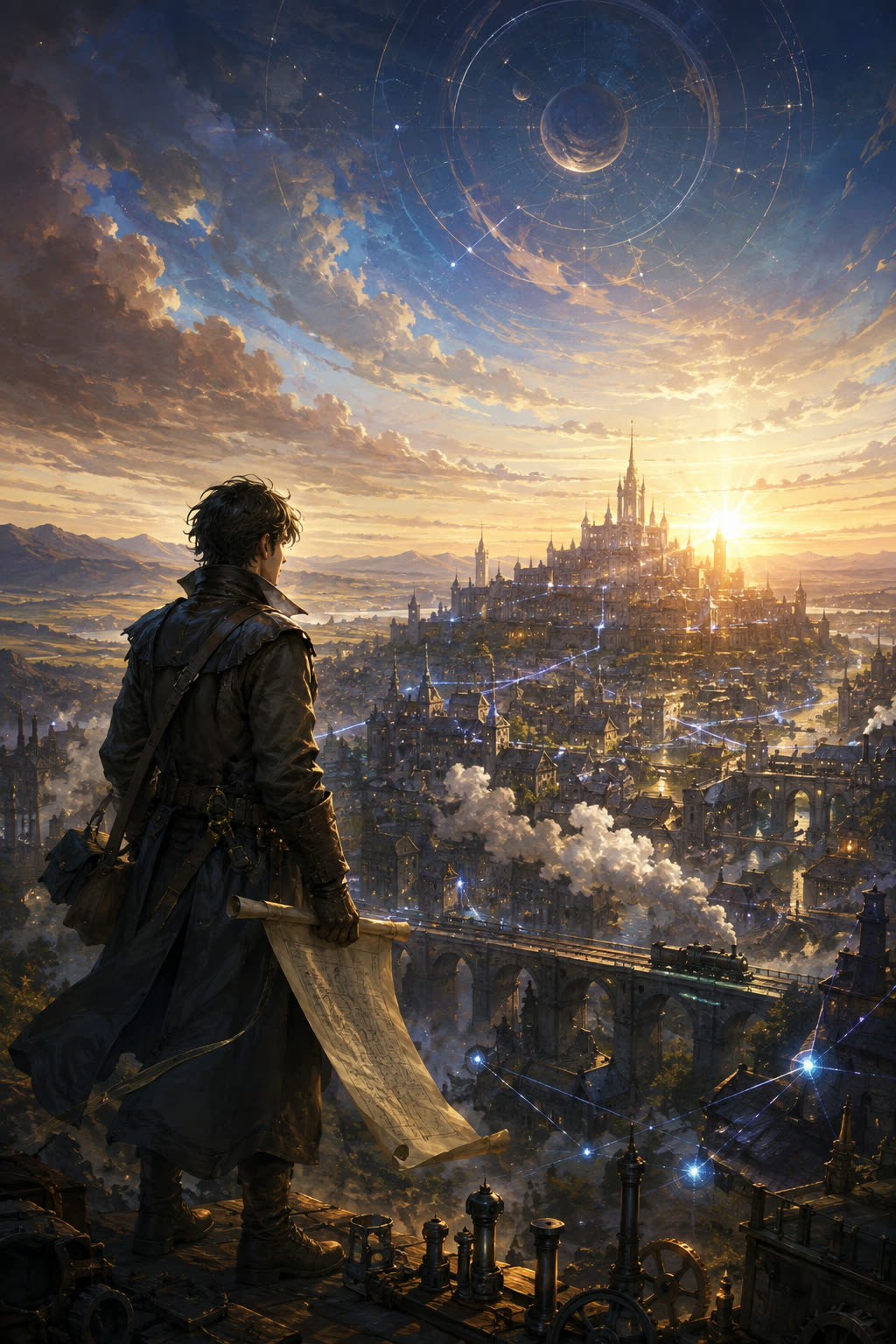
Gao Wen Cecil was a legendary hero who died centuries ago. His consciousness survived, bound to a satellite drifting far above the dying world of Loren, until the satellite fell and his mind reawakened inside the body of a distant, failing descendant. He wakes in a ruined border territory bearing his own name and finds a land gripped by fear: a great wall holds back a corrupted wasteland, the old gods are rotting, and the magic that once sustained civilization is failing. Rather than chase the glory of his past life, he decides to build.
The core engine of the story is engineering. Gao Wen treats the medieval world as a problem to be solved. He founds an academy, teaches commoners to read, and turns stolen cultist technology into the first version of a magical network that will one day carry voice, data, and power across the continent. Through his heirs Rebecca and Hetty and his half-elf guard Amber, Cecil Territory grows from a backward holding into the seed of an empire powered by steam, rails, and reason.
Beneath the farming lies a mystery the world has forgotten. As the territory prospers, Gao Wen uncovers the truth. The gods were never divine; they are corrupted management systems left behind by the Voyagers, the vanished race that built the planet as an ark. The periodic tides of madness that drown the land are symptoms of an ark running out of time. His war becomes one of survival for all thinking life, reaching from the wasteland to a stranded orbital station and finally to the doorstep of another civilization among the stars.
This is a science-fiction writer’s take on the fantasy isekai. The pleasures come less from sword fights than from watching a rational mind dismantle superstition, rebuild society, and confront the cosmic paperwork of a dying universe. The tone stays wry and grounded even as the stakes climb to the fate of everything.
II. Highlights
The Satellite That Remembered
Gao Wen opens his eyes long after his death, trapped in a coffin and a stranger’s body, and his first act is not to mourn but to calculate his way out.
The First Magical Network
By reverse-engineering a doomsday cult’s dream-tech, Cecil’s scholars build the prototype of a continent-spanning information grid centuries before anyone else imagines such a thing is possible.
Gods as Glitching Software
Beneath the cathedral, Gao Wen learns the divine is a corrupted operating system, and the holiest relic is a maintenance terminal nobody remembered how to log into.
The City at the Edge of Night
Amber inherits a metropolis of shadows where the dead keep house, and Cecil’s lost descendants have built a quiet civilization inside the dark.
IV
Should you read it?
Reasons to read
- Reasons to read You like progression fantasy where the progress is civilization itself, not just personal power.
- You want worldbuilding that actually explains its magic as a system.
- You enjoy a protagonist who wins with logistics, teaching, and stubborn common sense.
- Reasons not to read You came for romance, clan intrigue, or a brooding lone hero, because none of that is the point.
- You dislike exposition, since this book lectures lovingly and often.
Reasons not to read
- You want worldbuilding that actually explains its magic as a system.
- You enjoy a protagonist who wins with logistics, teaching, and stubborn common sense.
- Reasons not to read You came for romance, clan intrigue, or a brooding lone hero, because none of that is the point.
- You dislike exposition, since this book lectures lovingly and often.
Who it fits
- Reasons to read You like progression fantasy where the progress is civilization itself, not just personal power.
- You want worldbuilding that actually explains its magic as a system.
- Readers exploring Chinese web fiction.
- Fans of isekai who are tired of stat screens and want ideas instead.
- Anyone who likes watching a competent adult rebuild the world from a swamp.
- Readers looking for a different reading experience.
Reader community
Would you recommend it?
Register or sign in to recommend this novel and comment.
Reader comments
0 comments