I. Overview
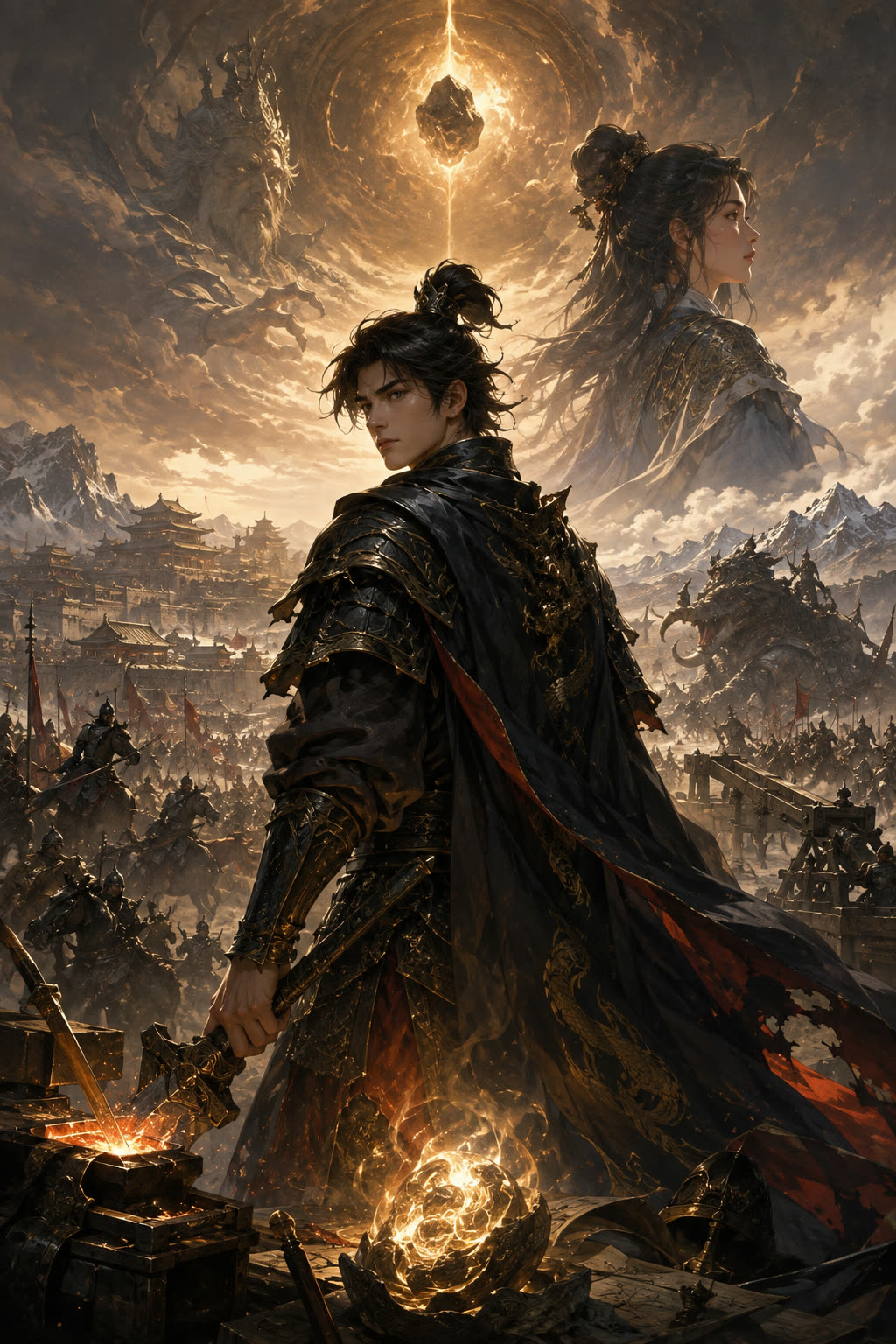
The Human Emperor is a Chinese web-novel colossus that fuses a Tang Dynasty alternate history with a full cultivation system, and it reads like a grounded military epic with a second-chance twist. Most xianxia heroes are heaven-blessed geniuses climbing toward immortality; Wang Chong is a twice-born strategist who already watched the world burn once. A modern slacker struck by a meteor, he wakes inside the body of a failing general’s son in a Tang-like empire and learns a mystical Stone of Fate has given him one life back. His edge is memory, planning, and a grudge against the traitor who broke his first world.
Wang Chong starts small. He opens the story not on a battlefield but inside a household on the verge of ruin, and he wins his first victories in the market: he rediscovers Wootz steel, perfects a quenching technique, and parleys a sword-duel for gold into a fortune and a private cavalry. Behind the merchant’s smile he recruits the future generals of a doomed empire and trains his own body in the primordial-qi arts. The court notices, rivals close in, and the boy everyone dismissed as a wastrel starts bending the fate of the realm.
The war widens by layers: from the Wang family compound in the capital, to the southwest campaigns where he breaks the Tibetan alliance, to the Talas plains where his ballistae face the beast-riding armies of the Abbasid Caliphate, to the An Lushan rebellion that nearly cracks the empire, and then upward into a hidden war of gods and talismans where Wang Chong fights a cosmic entity called Heaven itself, his power climbing from Primordial through True Martial, Imperial Martial, Sage Martial, the Micro and Cave-Heaven realms, to Divine Martial.
The book’s loudest traits are scale and cold calculation, yet a warm core holds it together. Wang Chong plans, waits, and kills when he must, but he keeps his sworn brothers close and leans on Xu Qiqin, his logistics commander and the love he would have married if Heaven had allowed it. Wang Chong delivers on one stubborn promise: granted one life back, he drags a civilization off the edge, and he earns every step with real hardware instead of vague posturing.
II. Highlights
The last marshal’s last charge
The book opens on apocalypse. Wang Chong stands as the final Grand Marshal of a fallen Central Plains, surrounded by otherworldly cavalry that have eaten every empire on the map. He lures the traitor into the open, takes him down in a suicide blast, and dies satisfied. Then he wakes at fifteen, unscathed, with the Stone of Fate humming in his skull. His own line sets the tone for everything after: “I will not hand this world to those I despise.”
The Wootz gambit
Early on, Wang Chong does something no general in the book manages. He rebuilds a lost steel, forges the first Wootz blade his age has seen, and wins a public sword-duel at Qingfeng Tower for a chest of gold. That gold buys loyalty, iron, and the first seeds of the Wushang Iron Cavalry. The scene sells the whole premise: this hero beats the world with a quartermaster’s brain.
Beasts at Talas
The Abbasid war turns strange. Caliphate commanders unleash giant beasts and Zhendan titans that trample whole formations, and the lines that held against normal armies start to buckle. Wang Chong answers with heavy ballistae, engineered fortifications, and the Wushang Iron Cavalry hitting where the titans cannot turn, then cuts down the caliphate’s legend Qutayba in single combat. It is the moment the military story and the monster story fuse for good.
The war above the war
Late in the book, Heaven’s organization takes Xu Qiqin, and Wang Chong’s companions raid the frozen north to bring her home. The rescue opens the final battle, where Wang Chong is pushed to Divine Martial and nine ancient sovereigns lend their dragon-qi so he can break Heaven itself. The lover he spent the whole arc protecting becomes the hinge of the world’s salvation.
IV
Should you read it?
Reasons to read
- A second-chance military mind. Wang Chong wins on memory, metallurgy, and logistics, and watching a nobody rebuild an empire's army is a different satisfaction from standard cultivation climbs.
- The history-meets-cultivation blend is rare. Tang generals, Talas, and An Lushan share the page with qi halos and titans, and the research shows in the hardware.
- The ending pays off. The cosmic turn could have collapsed into noise, but the final war lands because every general and gadget earned earlier returns.
- The Human Emperor is a Chinese web-novel colossus that fuses a Tang Dynasty alternate history with a full cultivation system, and it reads like a grounded military epic with a second-chance twist. Most xianxia heroes are heaven-blessed geniuses climbing toward immortality; Wang Chong is a twice-born strategist who already watched the world burn once. A modern slacker struck by a…
Reasons not to read
- It is enormous and the middle drags. Court intrigue, training arcs, and siege after siege ask for stamina a casual reader may not have.
- The romance is faint. If you want heat or a real love line, you will find only a loyal, backgrounded partner.
- Translation and culture gaps hit fast. The Tang references and the qi jargon arrive at once, and you meet a steep on-ramp.
- The imported guide still needs a final editorial pass.
Who it fits
- Fans of slow-burn strategy epics who like a hero winning on brains.
- Readers who want a complete ascent from gutter to throne with battles that escalate across a whole world.
- Anyone curious how a Chinese serial treats its own history as fuel for fantasy.
- Conversely, if you need speed, warmth, or a light tone, this book will feel like a siege you did not sign up for.
- Readers who want a complete ascent from gutter to throne with battles that escalate across a whole world.
- Anyone curious how a Chinese serial treats its own history as fuel for fantasy.
- Conversely, if you need speed, warmth, or a light tone, this book will feel like a siege you did not sign up for.
- Readers looking for a different reading experience.
Reader community
Would you recommend it?
Register or sign in to recommend this novel and comment.
Reader comments
0 comments