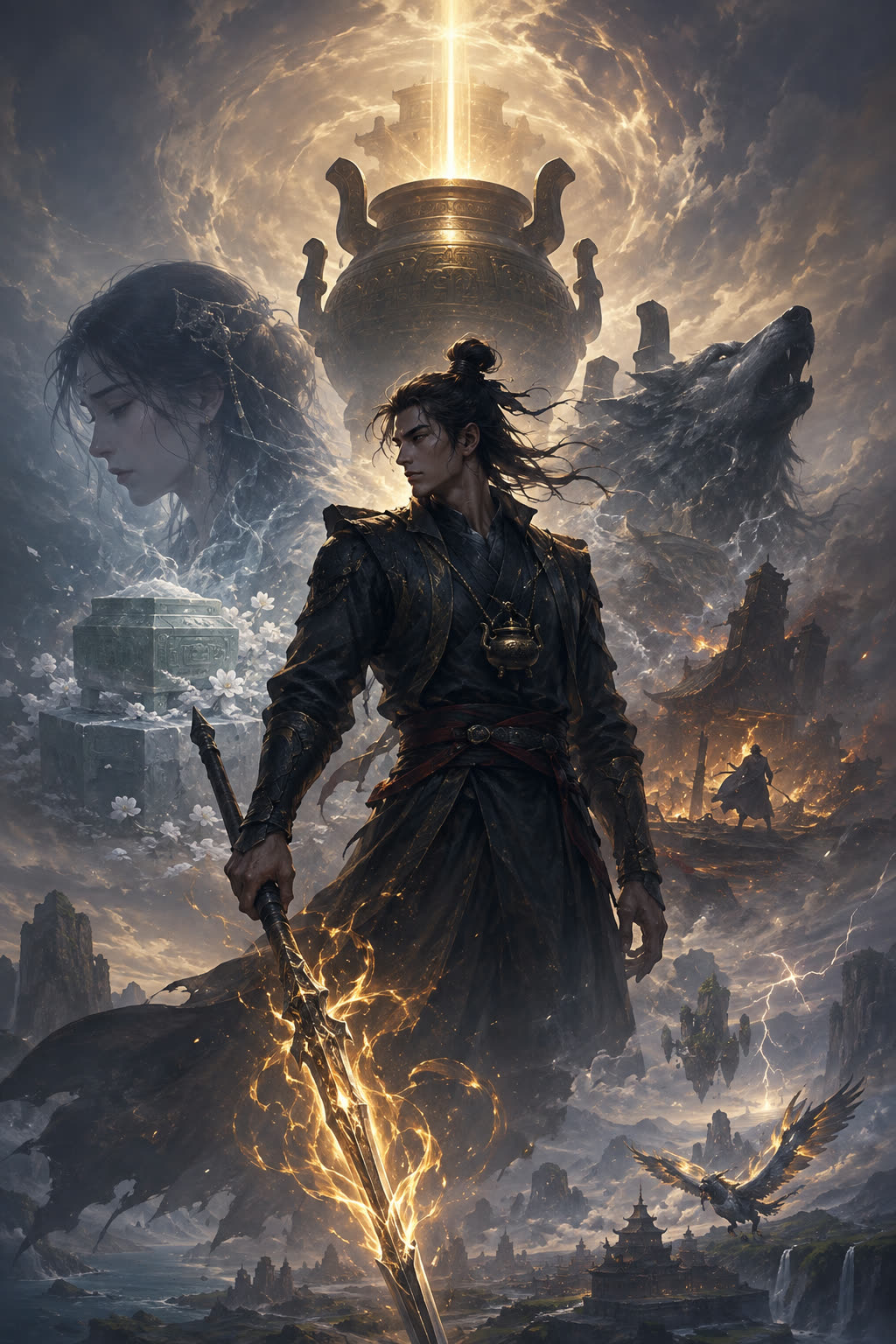
I. Overview
The Nine Cauldrons is I Eat Tomatoes’s wuxia novel, the one where grounded martial arts escalate into a xianxia-scale cosmic ladder. Teng Qingshan carries the story as a modern internal-boxing grandmaster and top assassin, code-named Wolf, who dies and wakes reborn as a baby in the Nine Provinces with every memory and muscle habit intact. His edge is a lifetime of Xingyi training, its root stance and its elemental fist forms, carried into a world that has never heard of them. He earns every rise through craft and patience, and the book treats his growth as a craft.
The opening moves in a double beat. A tight modern hitman thriller sets the hook: Wolf drills Xingyi in a quiet courtyard, wears a small black cauldron on a cord, and waits for the killers his old outfit sent to erase him. Then the story drops to a mountain village, where the reborn boy rebuilds his art with bare hands, forges a heavy spear from cold iron, and builds inner strength one breath at a time. The peace breaks when sect politics drag his family into a war, a cousin seized, a father maimed, the girl he loved cut down by an arrow. He answers with the Reincarnation Spear and a grudge that flattens an island.
The world widens from a single mountain village and its wolf hunts, to the barracks and rankings of the Guiyuan Sect, to the great sects carving up the Nine Provinces, to divine beasts that split the sky with lightning, to a continent across the northern sea, and finally to the void above the world where a handful of supreme beings decide what the land itself may become. He walks the elemental Daos, metal and fire first, then fuses life and death, and climbs from the Void Realm to the Cave-Void and beyond.
The book’s loudest traits are restraint and craft. It earns the climb through real martial logic instead of endless power inflation, and Teng Qingshan stays a guarded man who protects his family, mourns a dead wife, and marries the beast-taming girl he once pulled from danger. The romance stays quiet and the violence stays matter-of-fact, yet the hero never loses his center. It runs long, but it stays honest, and it closes with the hero at the peak he chased from the first page.
II. Highlights
The Wolf who fell out of the modern world
Before the Nine Provinces, Wolf was the deadliest freelancer in the business, a Xingyi master who killed an entire killer guild to avenge his murdered wife. The prologue drops you into his last quiet days: he drills the root stance in a courtyard at dawn, a small black cauldron warm against his chest, and waits for the snipers his old outfit sent. When they come, he moves like a tiger off a leash and ends the first before the man clears his weapon. The cauldron is why he comes back, and the book never lets you forget it.
A spear born from dying embers
Deep in a mountain mine, Teng Qingshan watches coals fade to red sparks and the move clicks. He drives his Reincarnation Spear into a tree trunk and the tip wakes a spinning vortex of force that blows a hole through the wood and topples the trunk. He names the technique for the embers that taught it. This is the book’s engine: a fighter who builds his own arts from what he sees, not from a manual handed down by masters.
The kiss on the ice-jade urn
War takes the girl he loves, the daughter of his own teacher, and leaves only an urn of ice-jade ash. Teng Qingshan kneels, pours wine, and presses his lips to the cold box, swearing to erase the island sect that took her. The moment turns a power fantasy into a personal debt, and the revenge that follows reshapes the map of the Nine Provinces.
The god who walked unseen
At the peak, Teng Qingshan leaves his family and walks the land as a ghost, bending light so no eye finds him. He watches a rich bully corner a poor woman and her son, and for once he does not step in, because a true student of the Way must first see the world as it is. The walk is his last lesson, and it carries him to the lake where he and Pei San, the other supreme being, break the sky together.
IV
Should you read it?
Reasons to read
- It grounds a god-tier power climb in real martial craft. Teng Qingshan wins through Xingyi logic, breath control, and a spear he forges himself, so the rise feels earned instead of granted.
- The world is built wide and tight at once. The Nine Provinces, the sects, the beasts, and the void above all lock together, and seeds planted hundreds of chapters early pay off at the end.
- For a Western reader tired of chosen-one cultivators, the hero's plain drive, his family, and his dead wife give the spectacle a human weight most long web novels skip.
- The Nine Cauldrons is I Eat Tomatoes's wuxia novel, the one where grounded martial arts escalate into a xianxia-scale cosmic ladder. Teng Qingshan carries the story as a modern internal-boxing grandmaster and top assassin, code-named Wolf, who dies and wakes reborn as a baby in the Nine Provinces with every memory and muscle habit intact. His edge is a lifetime…
Reasons not to read
- It is massive, and the middle leans on sect intrigue, rankings, and treasure runs that can stall before the cosmic payoff lands.
- The romance is faint and the tone is solemn. Readers who want heat, banter, or a passionate love line will find little.
- The prose is functional, not lush. Anyone hunting literary polish or a stylist's voice should look elsewhere.
- The imported guide still needs a final editorial pass.
Who it fits
- Fans of steady, craft-over-gift progression who like a hero climbing on skill and will.
- Readers who want a wuxia heart inside a xianxia-scale system, and who enjoy a world that unfurls layer by layer.
- Anyone who likes a complete arc from nobody to the top of the world.
- Conversely, if you need speed, warmth, or a light comedic tone, this book will likely sit on your shelf.
- Readers who want a wuxia heart inside a xianxia-scale system, and who enjoy a world that unfurls layer by layer.
- Anyone who likes a complete arc from nobody to the top of the world.
- Conversely, if you need speed, warmth, or a light comedic tone, this book will likely sit on your shelf.
- Readers looking for a different reading experience.
Reader community
Would you recommend it?
Register or sign in to recommend this novel and comment.
Reader comments
0 comments