I. Overview
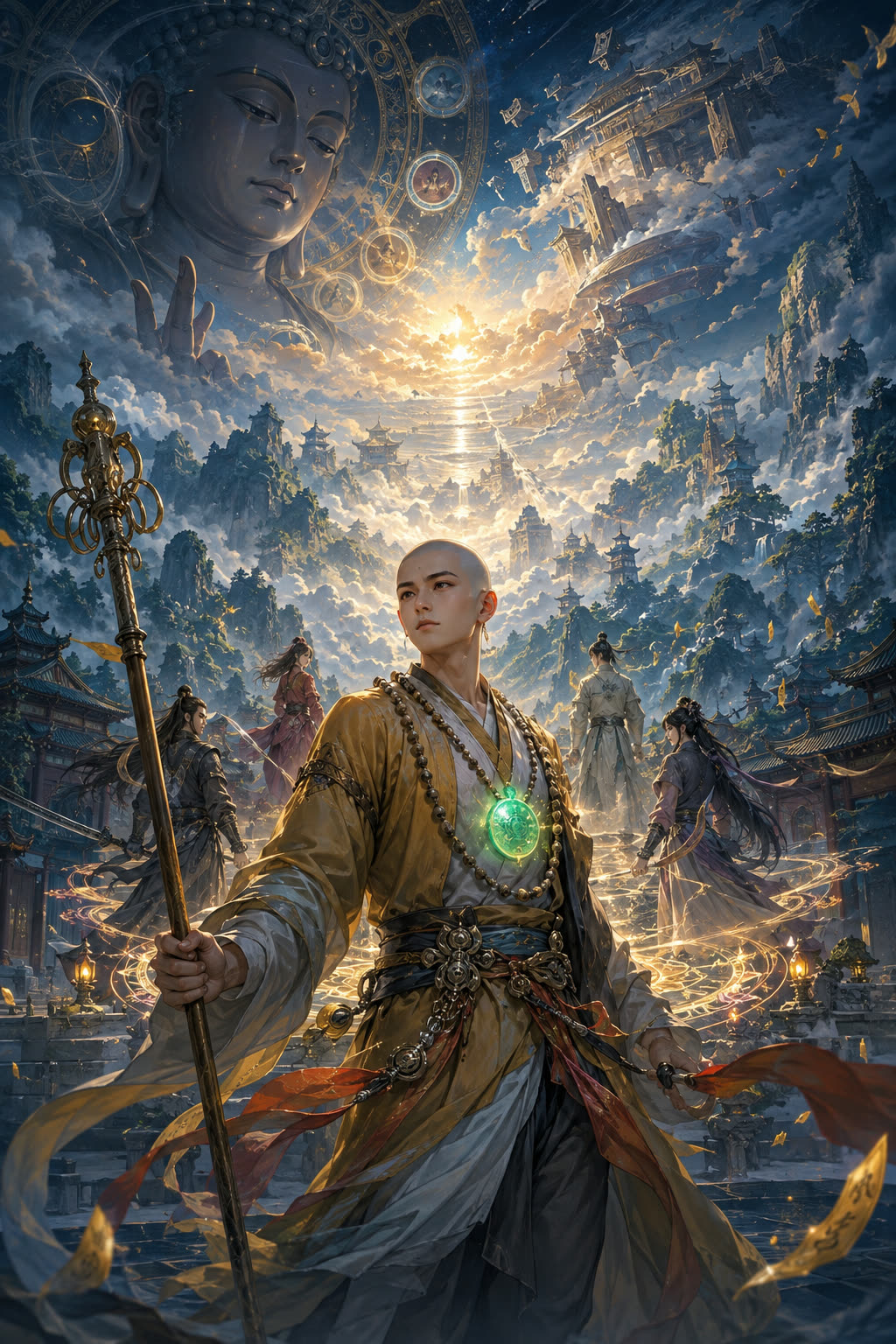
The Sage Who Transcended Samsara is a sprawling wuxia-to-xianxia cultivation novel by Cuttlefish That Loves Diving, the author of Lord of the Mysteries. The hero starts as a modern office worker who wakes up inside the body of a child monk in Shaolin, a transmigration premise with real teeth. Meng Qi wakes in a strange, ancient world with no memory of his new body, receives the dharma name Zhen Ding, and the Six Paths of Reincarnation drags him into a cosmic mission space that runs him and a small team through deadly trials for power. That premise carries the whole climb: an ordinary man leveraged into a war between godlike beings.
The early books stay grounded in the jianghu. Meng Qi runs errands, fights bandits, learns the monk’s staff and blade, and survives by quick wits as much as by cultivation. The reincarnation space turns the screw. Missions pay merit that buys the next technique, and techniques inch him up a ladder from Opening through Exterior Scene to Dharma Body. The danger feels personal because Meng Qi is not free. He learns he is the fish of the Demon Buddha Ananda, a fallen Buddha who planted him as a future vessel, which turns what looks like fortune into a slow countdown.
The world widens by layers into something vaster than any single hero. From the stone walls of Shaolin and the feuding sects of the jianghu, the story climbs through the great Buddhist temples and the ancient clans, then into the broken remnants of the Heavenly Court and Spirit Mountain, then to the level of the Other Shore, where beings like the Primordial Lord of Heaven, the Golden Emperor, the Heavenly Emperor, and the Demon Buddha himself treat the mortal world as a chessboard. Each rung swaps sword duels for cosmological stakes without ever dropping the personal thread.
Meng Qi’s voice lingers. He is clever, bawdy when the moment allows, loyal to the friends who rode the reincarnation missions with him, and refuses to be anyone’s pawn. The bond with his team, the sword genius Jiang Zhiwei and the steady Qi Zhengyan chief among them, gives the cosmic plot a human anchor, and his slow, wary romance with the scheming Gu Xiaosang earns its weight. By the end the book is less about winning fights than about a man throwing off the role gods wrote for him and paying the price to spare everyone else.
II. Highlights
A stranger in a monk’s robe
Meng Qi opens his eyes to a blue, cloudless sky and a face he does not recognize. He is a child, he is in Shaolin, and a nervous monk is fussing over him while calling him second young master. He remembers only a normal night watching the World Cup. His body carries a small jade Buddha at the chest and a princely jade pendant at the waist, and when the abbot asks his name he blurts that he has forgotten it, earning the dharma name Zhen Ding and a place among the menial monks. The reader meets the hero exactly as he meets the world: confused, talkative, and already scheming how to leave.
The mission board of the gods
Deep in the Six Paths space, Meng Qi huddles with Jiang Zhiwei, Qi Zhengyan, Zhao Heng, and Ruan Yushu, spending hard-won merit on the next edge. The voice of the space announces a Westward Journey raid: a fragment of the ancient Heavenly Court will surface on Mount Five Fingers, and the team must stop the demon kind from seizing its core. He offers to lead them to the Buddha’s Palm canon hidden at the Lanke Temple so they can train before the deadline. The scene shows the engine that drives the whole book, friends turning survival into strategy.
A shrine in the storm
Fleeing across the western desert, Meng Qi stumbles through a sandstorm to a small, new-looking shrine with a single oil lamp burning inside. A serene young monk welcomes the lost travelers, then the door opens on Zhen Guan, Meng Qi’s old Shaolin roommate, now scaled like a serpent and carrying a cloth bundle of pickled heads. Zhen Guan has become a half-demon avenger, and the quiet shrine turns into a standoff between two men who once shared a monastery bench. It is a small, eerie beat that captures how the book lets the familiar curdle into the strange.
The sermon at the end of the world
Late in the story Meng Qi sits among the dead as the Primordial Lord of Heaven, listening to his former master Xuan Bei preach in the role of Ksitigarbha. The epoch is ending, the Demon Buddha has swallowed the underworld, and Meng Qi explains his plan to fuse the old man’s afterlife realm with a salvaged ark so that some living thing might survive the collapse. The scene trades sword flash for quiet dread, a god calmly arranging the rescue of everything because he once promised a friend he would.
IV
Should you read it?
Reasons to read
- The plotting is dense and the reincarnation-mission engine keeps momentum; the author is known for schemes that pay off late, so early threads keep their sting.
- The full arc of a nobody becoming a god is the book's biggest sell, and the companion bonds give that climb a warmth most long cultivation stories lack.
- The mythological scale is handled with internal logic, which makes the cosmic endgame land for readers who enjoy god-tier fantasy done seriously.
- The Sage Who Transcended Samsara is a sprawling wuxia-to-xianxia cultivation novel by Cuttlefish That Loves Diving, the author of Lord of the Mysteries. The hero starts as a modern office worker who wakes up inside the body of a child monk in Shaolin, a transmigration premise with real teeth. Meng Qi wakes in a strange, ancient world with no memory…
Reasons not to read
- The length is enormous and the middle drags through seclusion, dungeon, and tournament stretches that test endurance.
- The cultivation terminology and the huge cast of mythic names can overwhelm a Western reader, and the available translation reads in a fan-style voice.
- The romance is faint and the final acts grow abstract, which can leave readers wanting more grounding.
- The imported guide still needs a final editorial pass.
Who it fits
- Fans of long, tightly plotted progression fantasy who liked Lord of the Mysteries, Cradle, or Reverend Insanity, and readers who want companions-and-leveling with a mythic payoff.
- Conversely, if you need a tight standalone, fast pacing, or a romance-forward story, this book probably is not your taste.
- Readers exploring Chinese web fiction.
- Conversely, if you need a tight standalone, fast pacing, or a romance-forward story, this book probably is not your taste.
- Readers looking for a different reading experience.
Reader community
Would you recommend it?
Register or sign in to recommend this novel and comment.
Reader comments
0 comments