I. Overview
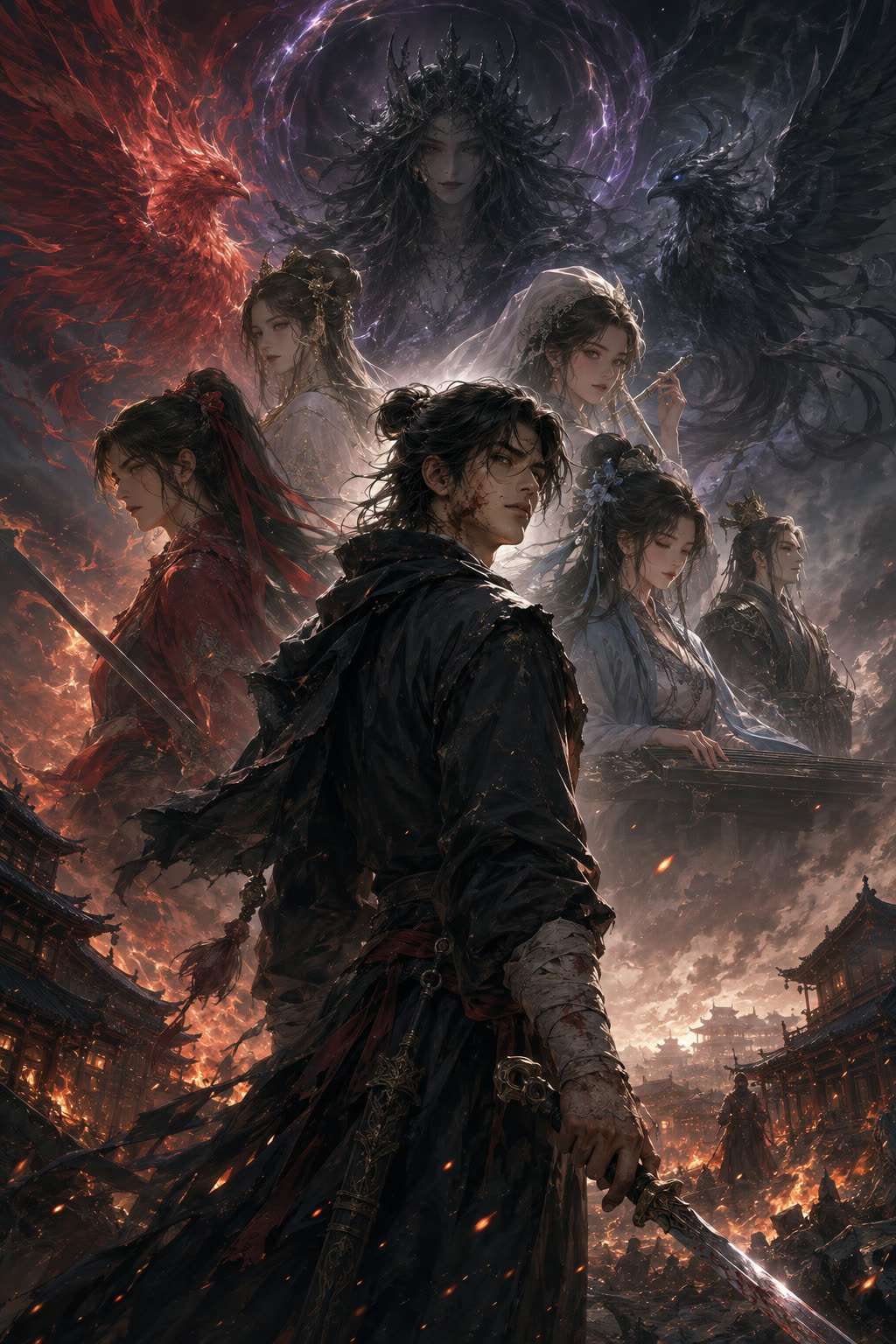
Tome of Troubled Times is a Chinese web novel that reads like a wuxia isekai with the scope of a full progression epic. Most cultivation stories hand the hero a heaven-blessed gift and a straight road up; Zhao Changhe starts as a college kid in a modern classroom. A blind fortune teller and a deck of cards pull him into a brutal martial world. He wakes outside a village mid-massacre holding a borrowed club, with no cheat and no master, only a bandit’s nerve and a grudge against the witch who keeps cutting his throat in his dreams.
The opening is raw and bloody. Zhao talks his way into a noble house, learns the world runs on nine mystic passes and three secret treasuries, then watches that house get erased by the Four Symbols cult and the Blood God sect in a single night. He answers by driving his blade through the throat of the young master who ordered the village burned, names himself to the wanted posters as “the killer, Zhao Changhe,” and walks into the demon sect as his own entry fee. The book never looks back from that feral first act.
The stage widens from one burned village to the wandering jianghu of blade singers and bandit chiefs, then to the crumbling Great Xia dynasty and its demon-suppressing office, outward to the Four Symbols cult with its masked Vermilion Bird and Black Tortoise venerables, deeper into ancient epochs of gods and the spirit clan, and finally past the human realm into the star sea and the war against the Heavenly Dao itself, where Zhao carries the Tome of Troubled Times as its Night Emperor and rewrites the rules of fate.
The book’s loudest traits are its warmth and its bite. Zhao is no cold genius and no saint; he is a loud, loyal, flirty survivor who wins fights on nerve and learns sword forms from the women who keep saving him. Around him a circle of distinct heroines, the red-clad swordswoman Yue Hongling, the ailing court chief Tang Wanzhuang, the cross-dressed holy maiden Xia Chichi, each carries her own arc, and the romance, for all its density, stays earned. It runs long and the late god-war stretches drag, but the climb stays believable: an ordinary man with a borrowed knife cuts his way to the top of the world.
II. Highlights
The Killer, Zhao Changhe
The night the demon cults erase the Luo household, Zhao stands among the burning halls with a blade through the young master’s heart. He had talked his way in as a harmless farm boy, let the arrogant lose their guard, then struck. When the cult’s Vermilion Bird Venerable and the court’s ailing chief watch him, he does not flee. He shouts his real name to the wanted posters: “The killer is Zhao Changhe.” That one line turns a scared student into a wanted man the whole world will learn to fear.
A Lullaby for the Ailing Chief
Tang Wanzhuang runs the empire’s demon-suppressing office, a prodigy of sword and scholar’s arts who has never been allowed to rest. Wounded and sleepless, she lets Zhao sit by her bed, and he picks out Twinkle Twinkle on a zither because it is the only tune he knows. The hard lines on her face smooth out and she falls asleep mid-song. It is a small, quiet moment in a blood-soaked book, and it tells you more about why Zhao wins people than any battle does.
Two Jealous Weapons
Zhao carries the royal blade Dragon Sparrow and borrows the ancient sword Dragon Emperor, and the two spirits hate each other so much they start dueling in midair and tear the courtyard down. Tang Wanzhuang cannot separate them. The fix is absurd: she bows to Zhao as “Crown Prince,” he plays along with a flustered “Rise, my minister,” and the embarrassed weapons, fooled into thinking their owner now holds the throne, quiet down at once. A cultivation epic that pauses for weapon slapstick is a rare thing.
The Vermilion Bird’s False Death
Late in the war against the Heavenly Dao, the Vermilion Bird Venerable lets the demon god of oblivion strike her down in front of everyone, her body withering to a single flickering flame. She fakes death so the blow shatters the cage the heavens built around her. She erupts from the flames reborn, wings blotting out the sky, the first of the new generation to break the old limits. Zhao’s women do not wait to be rescued; they tear the cage open themselves.
IV
Should you read it?
Reasons to read
- It blends jianghu adventure with a real progression climb better than most. Zhao starts with nothing but nerve and ends as the master of the world's source book, and every step feels earned rather than granted.
- The cast of women is the book's secret weapon. Each lead has her own agenda and growth, so the romance reads as a web of people, not a checklist.
- For a Western reader new to Chinese web fiction it is a gentle on-ramp: the early chapters are pure wuxia, the power system is easy to follow, and the humor travels across cultures.
- Tome of Troubled Times is a Chinese web novel that reads like a wuxia isekai with the scope of a full progression epic. Most cultivation stories hand the hero a heaven-blessed gift and a straight road up; Zhao Changhe starts as a college kid in a modern classroom. A blind fortune teller and a deck of cards pull him into…
Reasons not to read
- It is long, and the back half sprawls. Once the story leaves the martial world for god-emperors and star domains, the pace loosens and some stretches drag before the finale.
- The multi-partner romance is dense and fast moving. Readers who want a single focused love line, or who dislike that structure, will bounce off hard.
- The tone swerves from gritty to silly to cosmic without warning. Anyone wanting consistent seriousness may find the shifts jarring.
- The imported guide still needs a final editorial pass.
Who it fits
- Fans of progression fantasy and isekai who like a competent, funny lead and a clear power ladder;
- readers who enjoy large casts of strong female characters with their own arcs;
- anyone curious about Chinese wuxia but wanting a modern, fast, irreverent voice.
- Conversely, if you need tight literary seriousness, a monogamous romance, or a short book, this is not your read.
- readers who enjoy large casts of strong female characters with their own arcs;
- anyone curious about Chinese wuxia but wanting a modern, fast, irreverent voice.
- Conversely, if you need tight literary seriousness, a monogamous romance, or a short book, this is not your read.
- Readers looking for a different reading experience.
Reader community
Would you recommend it?
Register or sign in to recommend this novel and comment.
Reader comments
0 comments