I. Overview
Chinese cultivation fiction usually opens on a chosen genius. Unsheathed opens on a fourteen-year-old orphan delivering letters in a dead-end alley for a copper coin apiece. Chen Ping’an lives in Mud Bottle Lane, a back street in the porcelain town of Lizhu Grotto-Heaven, where the imperial kilns have just shut and the master who took him in is dead. He is barred from the start: his fate porcelain broke when he was five, the longevity bridge in his body snapped at fourteen, and the ladder every other protagonist climbs stays shut. What he has left is a body hardened hauling clay, a stubborn habit of keeping his word, and a knack for outlasting people who wrote him off.
The opening is patient, and poor. Feng Huo Xi Zhu Hou makes Chen Ping’an count coppers: a golden carp he cannot afford, a paper charm to pray for his dead parents, a mail route run for a gatekeeper who shortchanges him. Immortals stroll through town in plain clothes while he worries about staying fed. The stranger watching him closest is a Confucian scholar living out an exile in the village schoolhouse. Qi Jingchun teaches the boy to read, hands him a handful of seals, and when the grotto-heaven collapses and the town’s accumulated karma comes due, buys its people a future with his own life. Chen Ping’an leaves with a jade hairpin and one instruction: when you cannot decide, ask the spring wind.
Then Chen Ping’an starts moving, and the world keeps widening. He escorts schoolchildren across a continent to an academy in a hostile kingdom, learns to box from a sword girl who splits mountains, rebuilds the bridge in his own body, carries a blade south to the girl he loves, and lands on the Sword Qi Great Wall: out of Mud Bottle Lane, into the kiln towns and ranked river gods of his home continent, up through the Confucian academies that set policy for kingdoms across the World of Righteousness, onto a rampart carved with the names of the dead, past it into the Wild Lands, and at last into a fifth world the survivors carve from nothing.
Feng Huo Xi Zhu Hou writes about two things: rules, and what keeping them costs. Chen Ping’an climbs as a martial artist and swordsman rather than a cultivator and argues as often as he swings, with sect lords, emperors, river gods, and his own students, over who owes what to whom. Ning Yao, the sword genius who loves him and outranks him in every fight, keeps him honest across years apart, and the ragged disciples he gathers at Fallen Mountain turn a war story into a household, hanging spring couplets and squabbling over holiday food while the frontier burns. Stay with it and you get a payoff few epics try for: the boy from a dead porcelain town grows into the man everyone leans on, and never becomes anyone’s weapon.
II. Highlights
Eight strangers at the gate
Dawn has not broken when Chen Ping’an reaches the town’s rickety east fence, and eight outsiders are already waiting. A young man in an odd tall cap reaches for the gate, then stops and only smiles. A boy half Chen Ping’an’s height mouths two words at him. An old man in white gives him a look that makes him step back before he knows why. The gatekeeper, a drunk with his hand down his trousers, charges each of them for entry and pockets the money. Nobody explains a thing. The town up the road has been sealed for centuries, every one of these people wants something inside it, and the boy in straw sandals blocking the way has no idea he is blocking it.
Sword qi leaves the wall
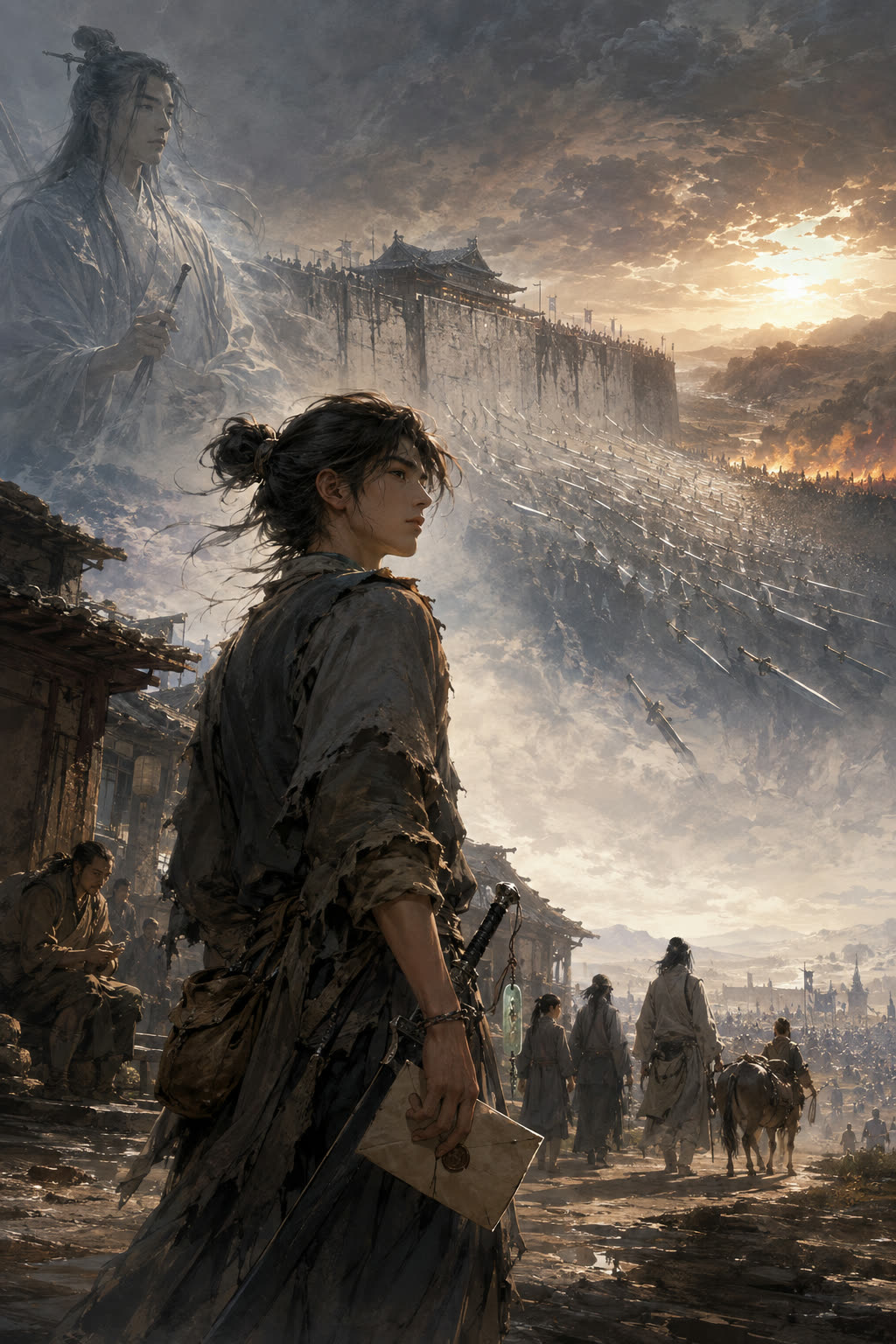
Look north across a hundred miles of wasteland and you can read the rampart, because the characters cut into it by sword qi are that large: “Dao, Fa, Haoran.” “The sword qi endures.” “Qi, Dong, Chen.” And one word standing alone: “Fierce.” Then a horn sounds out of the southern dark, the barbarian host lights its fires until the horizon burns, and the order comes down the wall: draw swords. Hundreds of thousands of blades leave the rampart at once and go south like a flood let loose. Chen Ping’an is nowhere near it yet. He is still walking a road with three children and a donkey, and the author lets you watch the war he is walking toward.
The Hidden Official’s ledger
By the time Chen Ping’an takes the post of Hidden Official, the war room on the wall runs on his arithmetic. His staff know every sword cultivator’s flying sword and innate technique by heart, and can stack dozens of sword formations out of strangers who never trained together. Two officers nearly come to blows after a plan gets two immortals killed. Chen Ping’an sits them down, tells them the fault is his because he wrote the rules, offers them a duel if they need to hit something, then opens the ledger and writes down everyone’s mistakes. They bet on whether he logged his own. He did, and he collects.
New Year’s Eve at the medicine shop
The war can wait one night. Chen Ping’an, his disciples, and a talking painting hang spring couplets, argue over who writes them straightest, cook a pork-shoulder stew, and hand out lucky money wrapped in red paper, one snowflake coin each. His student Pei Qian gets a thimbleful of osmanthus wine and treats it like a coronation. They sit up until dawn while Chen Ping’an and an old swordsman trade stories about the children they grew up beside in a town that no longer exists. Nobody draws a sword all night.
IV
Should you read it?
Reasons to read
- It runs on ethics instead of escalation. Chen Ping'an wins as often by arguing a sect lord into a corner as by out-drawing him, and the story treats "who owes what to whom" as the real fight. That is rare in a genre built on power scales.
- The world has institutional depth. River gods hold ranked offices and get audited, Confucian academies set policy for kingdoms, and the officers on the frontier wall keep ledgers. Feng Huo Xi Zhu Hou builds a civilization, not a backdrop.
- An English translation exists and is deep into the final stretch. Wuxiaworld has been serializing it for years under this exact title, and the animated adaptation streams as Sword of Coming, so you can put faces and voices to the names before you commit to the text.
- Chinese cultivation fiction usually opens on a chosen genius. Unsheathed opens on a fourteen-year-old orphan delivering letters in a dead-end alley for a copper coin apiece. Chen Ping'an lives in Mud Bottle Lane, a back street in the porcelain town of Lizhu Grotto-Heaven, where the imperial kilns have just shut and the master who took him in is dead. He…
Reasons not to read
- The book is enormous, and Feng Huo Xi Zhu Hou starts it slow on purpose. The opening stretch is a boy counting coins in a small town, and you sit in that for a long while before anyone swings a sword.
- Long passages are lectures. Characters quote Confucius, argue about ritual, and settle disputes with talk, which reads as preachy if you came for fights.
- The allusions will cost you. Classical poetry, Chinese history, and sect politics stack up with little hand-holding, and no translator can carry all of it across.
- The imported guide still needs a final editorial pass.
Who it fits
- Readers who like fantasy built at the scale of institutions, and who enjoy a protagonist who wins by being harder to move than anyone else.
- Patient fans of slow-burn progression and found-family warmth, the sort who liked the sprawl of The Wheel of Time or the restraint of Crouching Tiger, Hidden Dragon.
- Anyone who wants to see why Chinese web fiction has a canon of its own, and wants a way in that rewards attention rather than demanding homework.
- It is not for readers who need a payoff every chapter, dislike didactic narrators, or want a romance that carries the plot.
- Patient fans of slow-burn progression and found-family warmth, the sort who liked the sprawl of The Wheel of Time or the restraint of Crouching Tiger, Hidden Dragon.
- Anyone who wants to see why Chinese web fiction has a canon of its own, and wants a way in that rewards attention rather than demanding homework.
- It is not for readers who need a payoff every chapter, dislike didactic narrators, or want a romance that carries the plot.
- Readers looking for a different reading experience.
Reader community
Would you recommend it?
Register or sign in to recommend this novel and comment.
Reader comments
0 comments