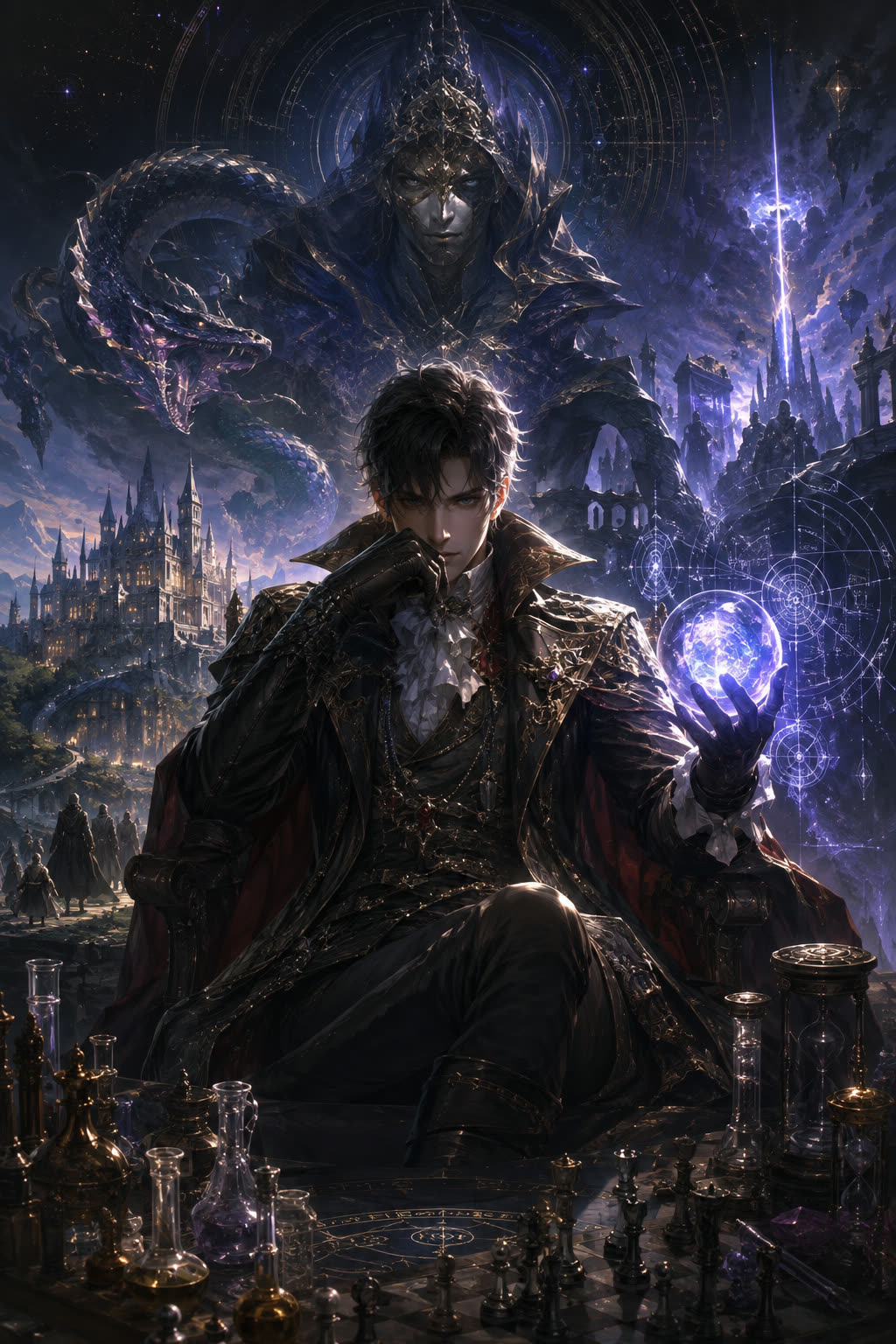
I. Overview
Warlock of the Magus World is a transmigration cultivation novel dressed in western fantasy. Most Chinese cultivation stories plant their hero in a vaguely medieval China of sects and immortals; this one drops a modern scientist’s mind into a D&D-flavored world of wizards, knights, and bloodline warlocks. The body belongs to Leylin Farlier, a small noble’s son who took a beating over a princess and died. The mind that wakes up is a transmigrator carrying an artificial “chip” that records, analyzes, and optimizes everything he touches. That chip is the whole game. It turns every potion, every duel, every whispered secret into data he can exploit.
The opening plays like a lab report with a blade. Leylin wakes in a wooden carriage bound for a wizard academy, inventories his new body, and sizes up the world as a specimen rather than a home. The chip logs his status, his aptitudes, and the weaknesses of everyone nearby. He slides in as a lowly apprentice, brews potions to fund himself, and survives the academy’s brutal culling where most aspirants are ruined, enslaved, or sacrificed by stronger wizards. Calculation keeps him alive where talent would not.
The world widens across planes and ladders. From the apprentice halls and the blood-soaked secret realms where white wizards and black wizards hunt each other for resources, the story moves to the great bloodline clans of the central continent, then outward through the World of Gods, the Dreamscape, and the highest rungs of the Magus World itself. Along the way Leylin takes the Kemoyin Serpent bloodline, forges the Seven Sins artifacts, and births a Sin True Spirit, climbing from knight to rank-eight Magus and finally toward godhood.
The book’s spine is cold and calculating. Leylin is no hero and no saint; he is a rational predator who befriends, betrays, and bargains strictly to extend his own life, yet he keeps a strange honor among his own kind. Romance stays faint and functional, a footnote to the climb. What lingers is the sheer pleasure of watching one sharp mind turn an entire universe into a solvable problem, and the quiet thrill of a man who starts as a dying noble and ends as a god.
II. Highlights
The carriage that remembers
Leylin wakes with a split skull and a stranger’s memories flooding in. Instead of panic, he runs an internal diagnostic: body weak, father a minor viscount, a family ring that buys him academy entrance, a reputation as the local bully. He greets his new world the way a scientist greets a new instrument, already plotting how to use it before the carriage reaches the gates.
The secret-realm bloodbath
White and black wizards pour into a contested realm to seize its treasures, and the apprentices are cannon fodder. Leylin does not charge. He lays traps, reads enemy formations through the chip, and strikes only when the odds flip in his favor, walking out while older and stronger wizards are stripped for parts.
The traitor’s keep
Now a law-enforcer of the Ouroboros Circle, Leylin arrives at a betraying bloodline house and simply states the charge. When the old wizard protests his authority, Leylin answers with a black beam through a captive beast’s skull and the order to kill every kinsman. No rage, no speech. Just the cost of disloyalty, collected.
Arbitrating the Dreamscape
At the peak, Leylin faces the Calamity Lords and the Dreamscape Will that made him its weapon. He casts off its control, dons the silver armor of Pride, and crushes a lord who thought his three lives made him unkillable. The scene lands because he wins not with raw power alone but with preparation laid down a hundred chapters earlier.
IV
Should you read it?
Reasons to read
- The AI-chip framing sets it apart from typical cultivation. Watching Leylin turn every mystery into measurable data and every foe into a solvable equation is a different, addictive pleasure.
- The scope is huge but coherent. Bloodlines, artifacts, and seeded plans pay off across volumes, and the leap from a wizard academy to godhood feels earned rather than handed over.
- Warlock of the Magus World is a transmigration cultivation novel dressed in western fantasy. Most Chinese cultivation stories plant their hero in a vaguely medieval China of sects and immortals; this one drops a modern scientist's mind into a D&D-flavored world of wizards, knights, and bloodline warlocks. The body belongs to Leylin Farlier, a small noble's son who took a…
Reasons not to read
- The protagonist is a cold optimizer. Readers who want a likable hero, moral warmth, or emotional stakes will find him distant and sometimes ugly.
- The middle drags through research, seclusion, and political maneuvering, and the western-fantasy jargon (wizards, gods, Weave) demands tolerance for a different mythos than standard xianxia.
- The imported guide still needs a final editorial pass.
Who it fits
- Fans of rational-protagonist and litRPG-adjacent stories who enjoy watching a mind game out an entire world;
- readers who like slow-burn power climbs with real payoff and a vast, consistent setting;
- anyone curious what Chinese web fiction looks like filtered through D&D and hard science.
- Conversely, if you need a warm hero, fast action, or a romantic core, this book will leave you cold.
- readers who like slow-burn power climbs with real payoff and a vast, consistent setting;
- anyone curious what Chinese web fiction looks like filtered through D&D and hard science.
- Conversely, if you need a warm hero, fast action, or a romantic core, this book will leave you cold.
- Readers looking for a different reading experience.
Reader community
Would you recommend it?
Register or sign in to recommend this novel and comment.
Reader comments
0 comments