I. Overview
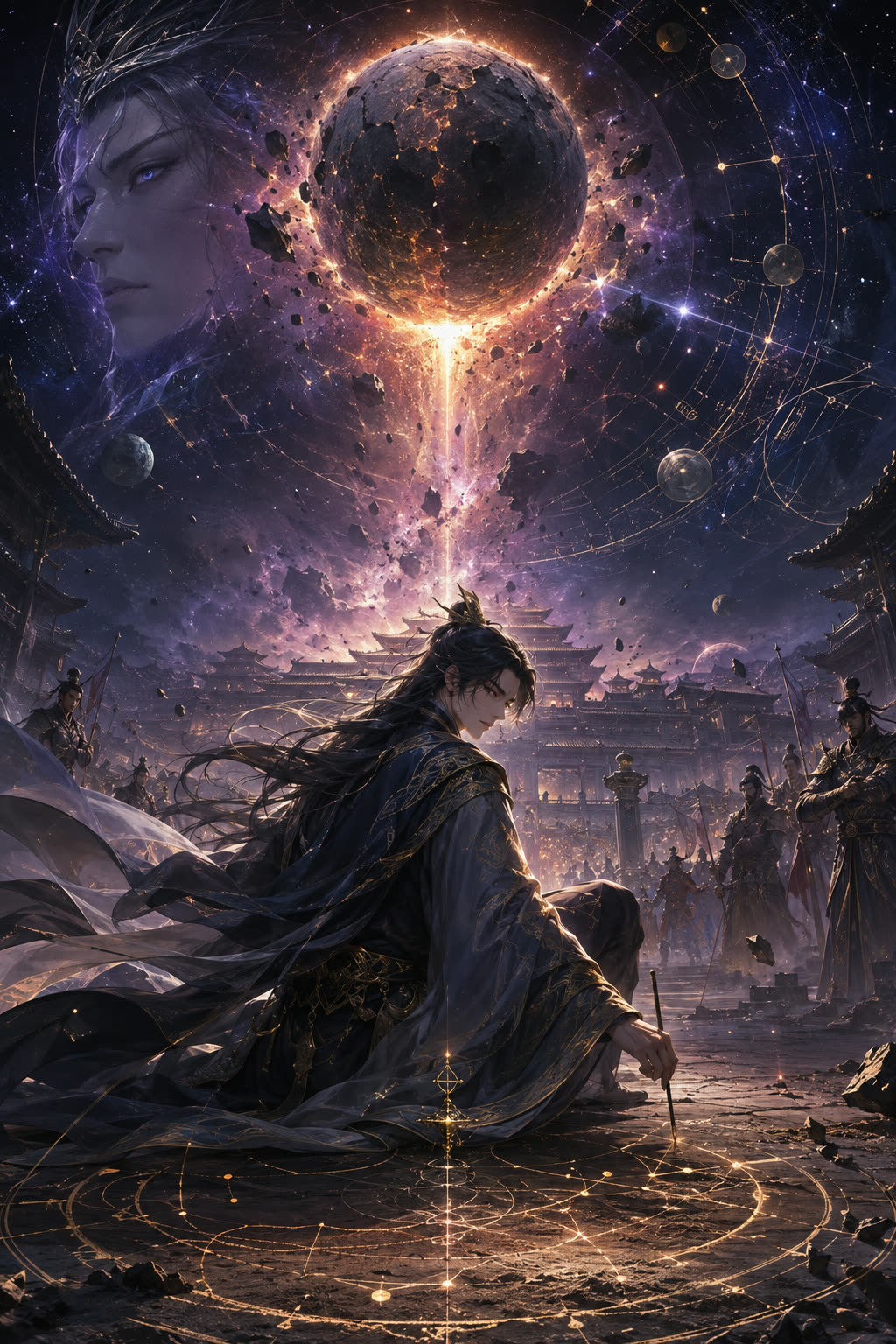
Gu Qing looks like a useless seventh son married into the Xu household, the kind of man servants pity and his wife’s guards humiliate. He spends his days scratching orbits into the dirt of a courtyard. What the Great Qi Dynasty never learns is that those scratches are real calculations. Gu Qing is the reincarnation of the Azure Emperor, and he has spent three years plotting the exact moment to drop a two-hundred-kilometer asteroid called the Divine Moon onto his own star. The book opens with that mind already running, and it never stops.
His weapon is not a sword alone but the sky itself. Gu Qing practices Star Drawing, a forbidden art that bends the gravity of distant stars into his reach and turns whole star orbits into siege engines. When the Xu family and the royal court push him, he answers by dragging a meteor into their sky. When the Blazing Sun Sect rejects him, he walks onto its holy altar and declares, out loud, that he will sit in the master’s seat. The early volumes read like a court intrigue that keeps detonating into astronomy.
The story then climbs a ladder most cultivation novels only describe in passing. Gu Qing moves from the Qi Dao of mortals through the Dan Dao of alchemists, the Shen Dao of god-realized masters, and finally the Sheng Dao of sages who treat galaxies as chess pieces. He is exiled, vows to return within a century, and does. Each realm widens the stage: a single city becomes a star, a star becomes a sect, a sect becomes a war between the Heavenly Dao and the will that wants to shatter it.
The engine underneath all of it is identity. The Azure Emperor is not just Gu Qing’s past life; he is the rival living in Gu Qing’s own body, the inner demon who seizes the flesh and forces a battle of souls for ownership of the self. Xing Shen Ji is a cold, grand, calculation-driven power fantasy where the hero’s greatest enemy and greatest inheritance are the same person, and where the final move is not to win a fight but to break the rules of the universe that wrote it.
II. Highlights
The Man Who Dropped a Moon
Gu Qing hides a reincarnated emperor’s memory inside a laughed-at son-in-law. The first real glimpse of his power is not a duel but a calculation coming due: a projected asteroid, a star’s gravity bent to his will, and a court that mocked him now standing under his sky.
The Sect Throne He Claimed in Absentia
Stripped of rank and sentenced to death by the Blazing Sun Sect, Gu Qing does not beg. He announces that the master’s seat is already his, flees on a beam of starlight, and leaves the sect’s elders to stew for a hundred years he fully intends to collect.
Star Drawing as a Weapon of War
When five god-realm masters surround him, Gu Qing does not trade blows. He reaches across light-years, grabs the gravity of a whole star, and grinds their formation into blood mist. The technique reads like orbital mechanics with a killing edge.
The Emperor in the Mirror
The climax is a soul wrestle. The Azure Emperor has worn Gu Qing’s body; Gu Qing dives back in to take it, realm against realm, until the question stops being who is stronger and becomes who is real. The Heavenly Dao itself is the last thing either of them has to defeat.
IV
Should you read it?
Reasons to read
- You want a pure progression fix where the power system is astronomy and the payoff is reshaping the heavens.
- The reincarnation-as-inner-demon twist gives the standard climb a genuine identity conflict instead of a flat power curve.
- The scale escalation, from one kingdom to the Heavenly Dao, is consistent and genuinely ambitious.
- Gu Qing looks like a useless seventh son married into the Xu household, the kind of man servants pity and his wife's guards humiliate. He spends his days scratching orbits into the dirt of a courtyard. What the Great Qi Dynasty never learns is that those scratches are real calculations. Gu Qing is the reincarnation of the Azure Emperor, and…
Reasons not to read
- Romance and humor are almost absent; readers wanting heart or comedy will find the lead remote.
- The later volumes are dense with realm names and mechanics that demand close attention.
- The imported guide still needs a final editorial pass.
Who it fits
- Hardcore cultivation and progression-fantasy readers who prize system depth and escalating stakes over character warmth or comedy.
- Readers exploring Chinese web fiction.
- The later volumes are dense with realm names and mechanics that demand close attention.
- Who it fits Hardcore cultivation and progression-fantasy readers who prize system depth and escalating stakes over character warmth or comedy.
- Readers looking for a different reading experience.
Reader community
Would you recommend it?
Register or sign in to recommend this novel and comment.
Reader comments
0 comments